
Table of contents
Employer for the first time?
Hiring your first employee means registering as an employer, notifying the right authorities and meeting all legal requirements. Check out our guide, which walks you through the process step by step:
Also, explore these practical guides to get you on the right track:
Association as an employer (MLL, in Finnish)
Handbook covering board responsibilities, genuine work requirements, recruitment processes, employment contracts and key labour laws—plus tips on smooth board operations and supporting employee development.
Association as an employer (II, in Finnish)
Guide that walks your board through every statutory obligation once you hire staff: labour-law compliance, contract management, tax duties and creating a safe, healthy workplace.
What are the employer responsibilities?
When an association hires someone — even for a short-term project — it becomes an employer and must follow certain legal responsibilities in Finland. These responsibilities help ensure that work is done safely, fairly, and in accordance with Finnish labour laws.
As an employer, an association must manage several key tasks. Understanding these responsibilities supports smooth cooperation and protects both the employee and the organisation.
🔗Palkkaus.fi and 🔗Yrittajat.fi state that when an association hires an employee, it is responsible for the following:

Employment Contract: Make a written agreement that defines the job role, salary, working hours, and other conditions.

Occupational Health Care: Provide free preventive health care services to support the employee’s well-being at work.

Workplace Safety: Ensure the work environment is safe and take steps to prevent accidents and health risks.

Insurance Obligations: Take out mandatory insurances such as accident, pension (TyEL), unemployment, and group life insurance (if required).

Payroll Management: Deduct taxes and contributions, pay net salary to the employee’s bank account, and provide a payslip.

Incomes Register Reporting: Report salary and payment details to the Incomes Register within five days of each payment.

Payments to Authorities: Pay withheld taxes and statutory contributions to the Tax Administration, pension provider, and Employment Fund.

Equality, Non-discrimination and Privacy: Promote equality at the workplace and protect the employee’s right to privacy and fair treatment.

Even though employment laws and collective agreements can be complex, the most important thing is to know where to find reliable information and follow the necessary steps. This guide will walk you through the main responsibilities of associations as employers and provide practical tools to support your work — starting with the employment contract.
In addition to understanding legal obligations, it is important to recognise that associations operate as workplaces with specific characteristics. Board members may have operational roles, employees often work closely with volunteers, and activities may take place outside standard office hours. Clear definitions of employer representation, supervisory arrangements and responsibilities help ensure compliance and prevent misunderstandings.
How to recruit the right person?
Hiring even one employee makes your organisation an employer under Finnish law. This means you must handle contracts, taxes, insurance, occupational health care, and payroll responsibilities correctly.
Good planning helps you find the right person, avoid misunderstandings, and keep costs under control.
Useful resources
Guide to Hiring Your First Employee – Suomen Yrittäjät
This guide gives clear advice on how to plan recruitment, define roles, write job ads, choose channels, and carry out interviews. It also covers onboarding and employer responsibilities like contracts, payroll, and workplace safety.
What do I do? Recruiting an employee – Suomi.fi
It offers a detailed recruitment guide for companies, but associations can also find useful instructions there.
Recruitment – Job market Finland
Practical information on different recruitment methods, forms of employment, wage subsidies, and job advertising. Includes tips for creating a good job advertisement.
What should you do before recruitment?
- Write a clear job description:
What does the job involve and what skills are required?
- Decide employment type:
Is it a permanent, fixed-term, project-based or outsourced position?
Note: Alternative ways to employ someone
There are several ways to hire a worker. Job Market Finland gives a general overview of the most common employment types: 🔗Different ways of employing people
What steps must the employer take?
If your association is considering options like pay-subsidised employment or work try-outs, Suomi.fi explains the full process for each option, including how to apply, and what conditions must be met: 🔗Find the right employee - employer’s process
- Calculate the real cost of employment:
salary, employer contributions, insurance, occupational health care, and possible equipment.
Suomi.fi offers a simple tool to help estimate this: Calculate 🔗Calculate employment costs (Suomi.fi)
- Check your budget and any available wage subsidies or grants:
Can your association afford to pay a salary? Are there any wage subsidies available?
This guide lists the main funding options and how to apply: 🔗What financial support can I get to hire an employee? (Suomi.fi)
How to organise the recruitment process?
Prepare a job advertisement,that states:
- the job title
- the job description
- the qualification requirements and necessary skills (what is required and what would be good to have)
- practical information, such as working hours, location (remote, hybrid, or office), salary, and contract duration
- application instructions, such as the application deadline and application method
- contact information
- data protection
Keep the advertisement clear, concise, and motivating
*Reminder 🔗The Non-Discrimination Act requires equal treatment of jobseekers. You are not allowed to require attributes that are not essential for the performance of the job. These include age, ethnic or national origin, nationality, language, gender, sexual orientation and family relationships.
Where can you publish your ad?
Job market Finland (Työmarkkinatori)
National platform where you can publish job ads and reach jobseekers across Finland.
LinkedIn, Social media
Popular tools to promote job ads through your network and reach specific audiences.
Local bulletin boards, partner NGOs
Informal channels to reach local jobseekers or communities connected to your organisation.
Europass (for international recruitment)
EU platform for publishing jobs and reaching candidates across Europe.
How to select candidates fairly and transparently?
- Use an evaluation form or scorecard: This is a simple tool that helps you assess job applicants in a structured and objective way, during or after interviews. It reduces bias and ensures all candidates are rated by the same criteria. A consistent scoring method makes the selection process fairer, strengthens your association’s image, and helps justify your decision if needed.
A typical form includes Background and relevant work experience, Skills and qualifications, Cultural fit (Do their values match your association? ) and Behaviour during the interview (e.g. interest, attitude, communication, …).
Find more information and templates here:
- Screen and shortlist applicants: Review applications using your evaluation form/scorecard. Select 3–5 top candidates. Avoid questions or criteria unrelated to the job.
- Keep records of your selection process: Save all key documents (job ad, applications, evaluation forms, interview notes and final contract). These may be needed later if questions come up from funders or members.
Employment Contract – Why is it important?
When your organisation hires someone, whether for a small project or a longer-term role, it is essential to create a written employment contract. While verbal agreements are legally binding in Finland, a written contract helps avoid misunderstandings by clearly outlining roles, responsibilities, and conditions from the start.
Why a written contract matter?
A written employment contract:
- Protects both the employer and the employee
- Defines working conditions such as salary, hours, and responsibilities
- Prevents conflicts by setting expectations
- Is often required when applying for grants or benefits
What should be included?
🔗Palkkaus.fi indicates that a comprehensive employment contract in Finland should include:
- Employer and employee details
- Start date of employment
- Work location and main duties
- Salary, payment schedule, and working hours
- Applicable collective agreements (TES), if any
- Duration and justification for fixed-term contracts (if applicable)
- Agreed probation period (if any))
- Holiday and notice periods, as required by law
Templates and examples
Moniheli's template
Designed for small-scale work, especially projects funded by the Moniheli grant, this simplified template is ideal for associations that employ staff occasionally. It is available in Finnish and English. It includes:
- A section for personal and contact details
- Job description and employment terms (including salary or fee)
- Signature fields for both parties
- Clear distinctions between “palkka” (salary) and “palkkio” (fee) (see explanation in the compensation section below), with notes on the employer’s obligations regarding insurance and pension payments
Työsopimus.fi (in Finnish)
This site provides practical examples and templates for employment contracts in Finnish, helping ensure that your contracts meet legal requirements.
Work contract template – Palkkaus.fi (in Finnish)
The article "Työsopimus" includes also helpful explanations and links to various contract templates. It’s a great resource for drafting legally sound agreements.
How to manage payroll, compensations and taxes?
Note!
Before you pay wages, check whether your association must register as an employer. You also need to know how to use tax cards and the Incomes Register. If you haven’t done that yet, read: 🔗How to register as an employer (guide).
How to compensate for work?
An association can pay people for their work in different ways. Each option has rules and limits. Always make sure compensations are paid correctly and recorded clearly in your accounts (e.g. “tax-free daily allowance for volunteer work”).
What is the difference between salary (palkka) and fee (palkkio)?
- Salary: paid when the work is performed within an employment relationship. The employee works under the employer’s direction and supervision, follows agreed working hours, and typically uses the organisation’s tools or premises. In this case, the organisation has full employer obligations, such as withholding taxes and paying pension and insurance contributions.
- Fee: usually paid for a specific assignment that does not constitute an employment relationship. The person works independently and is not under the employer’s direction and supervision in the same way as an employee.
Important: The name of the payment does not determine its legal nature. If the work meets the criteria of an employment relationship, the compensation must be treated as salary, even if it is called a “fee”.
a) Salary
If the person does not send an invoice for their services, the association normally pays a salary.
These payments must always be made using the person’s tax card and reported to the 🔗Incomes Register.
You cannot avoid employer obligations by paying someone informally to their private account. If the work is actually employment (the person works under your supervision, follows your schedule, and uses your tools), it must be paid as salary with taxes and employer contributions.
In order to calculate salary and employer’s cost correctly, an association should register as an employer if necessary and must arrange statutory employer obligations (for example pension insurance (TyEL), statutory accident insurance and occupational health care).
In Finland, salaries are usually paid via online payroll services such as palkka.fi or palkkaus.fi.
b) Light entrepreneurship
If the person doing the work act as a light entrepreneur, they may send an invoice for their work. In that case, the association does not pay salary, only the bill.
A light entrepreneur can temporarily act as if they had their own company and use a light entrepreneurship service (like UKKO.fi, eezy.fi, OP kevytyrittäja, etc.).
Note! You can’t require invoicing if the work is in practice an employment relationship!
If the person works under your supervision, follows your schedule, and uses your tools, it can legally be considered employment. In that case, you must pay them as an employee, with taxes and employer contributions.
False self-employment (näennäinen yrittäjyys) can lead to back taxes and penalties.
c) Compensation for unpaid volunteer work
Volunteers may receive tax-free daily allowances for their participation in unpaid volunteer work (including referees and judges). This is possible for small, one-off payments, without using a third-party service.
No formal documentation is required, but it is good practice to ask the volunteer to sign a simple receipt (the printed payment, dated and signed by the volunteer) or an acknowledgment letter.For bookkeeping, record the payment clearly (e.g. “tax-free daily allowance for volunteer work”).
This allowance can be paid for a maximum of 20 days per year per person. Although tax-exempt, they must be reported to the Incomes Register under “Daily allowance paid by non-profit organisation (358)”..
How are salaries and other compensations paid and reported?
Associations have several common ways to handle work payments:
- Association pays salary directly or via a payroll service (esim. Palkka.fi, Palkkaus.fi).
- Worker invoices as light entrepreneur (e.g. UKKO.fi, Eezy.fi) but only if the work is not actual employment! You only pay an invoice in this case.
If the association pays salary, the workflow in short is:
- Collect the worker’s personal details and their valid tax card (verokortti).
- Calculate salary and side costs: gross pay, tax withholding, pension, unemployment, and accident insurance.
- Pay the salary: transfer the net salary to the employee’s bank account.
- Report the payment to the Incomes Register within 5 days.
- Pay employer contributions: send insurance and tax payments to the right authorities (TyEL, unemployment fund, Tax Administration).
If you use a payroll tool like Palkka.fi or Palkkaus.fi, many of these steps happen automatically.
a) Palkanlaskentatyökalujen käyttö
Palkka.fi – for very small organisations
- Free official payroll service from the Finnish Tax Administration.
- Only available in Finnish and Swedish.
- You must make separate insurance contracts (TyEL, accident, etc.) with insurance companies.
- Reports automatically sent to the Incomes Register.
Palkkaus.fi – for SMEs and accounting firms
- Private payroll service.
- Paid service: self-service online 14€ / salary (VAT 0%).
- Insurance contracts are handled automatically. No separate contracts needed.
- Easy to use, with a clear interface.
- Reports automatically sent to the Incomes Register.
- Available in Finnish, English and Swedish.
b) What do you report to the Incomes Register?
Income Register is Finland’s central electronic system where employers report all wages, salaries, benefits, and withholding taxes. Associations submit data about wages, fees, or compensation paid to employees within five calendar days of the payment date, using the Earnings Payment Report.
What data is included? (🔗Incomes Register - Earnings payment data):
- Wages: Regular salary, overtime, bonuses, etc.
- Fringe Benefits: Such as car benefits, meal vouchers, etc.
- Reimbursements: Tax-exempt expenses like travel allowances.
- Non-Wage Compensation: Payments not classified as wages.
- Employee Contributions: Withheld taxes, pension, and unemployment insurance contributions
c) Are there other contributions to report?
In addition to the earnings payment report, associations must submit an 🔗Employer's Separate Report to the Incomes Register.
This report covers:
- Employer's Health Insurance Contribution: Calculated based on the employee's gross earnings.
- Other Employer Contributions: Such as accident insurance, if applicable.
The report must be submitted by the 5th day of the calendar month following the payment month
How are occupational health, safety and insurance arranged?
Associations as employers have the principal responsibility for ensuring that the workplace is safe and healthy. Their two main responsibilities are arranging occupational health care for employeesand ensuring workplace safety through a proper action programme and risk assessments.
How to provide occupational health care for employees?
Under the 🔗Occupational Health Care Act, all employers must provide statutory occupational health care for employees. This includes preventive care, guidance, and work-related medical services. The goal is to support employees’ work ability throughout their working careers.
Employers must collaborate with occupational health care providers to create an action plan, which should be reviewed at least once a year (Occupational Safety and Health Action Programme).
a) What is included in statutory occupational health care?
- workplace surveys on the impact of work and the work environment on the health of employees
- advice and guidance on the maintenance of health and work ability either one-on-one or in groups
- doctor’s examinations, at the start of employment and at regular intervals
- promoting the functionality of the work community
- monitoring of work ability and referral to rehabilitation
- monitoring of sick leaves and accident prevention together with the workplace
- participation in the arrangement of first aid.
Every workplace must have a practical plan showing how employees’ work ability will be maintained.
b) What are the practical steps to implement occupational health care in your association?
- Make an agreement with an occupational health provider before the employee starts. Providers can include:
- Wellbeing services county healthcare units
- Municipal or private companies providing occupational health care
- Occupational health care centres run by several employers
- Private medical centre occupational health units
- Keep the agreement and the workplace survey report in a place accessible to all the employees.
- Report new employees to the occupational health provider and schedule a health check if needed.
How to ensure workplace safety and health?
Employers are responsible for providing safe and healthy working conditions. They must make sure that:
- working conditions do not harm employees’ health or safety,
- risks are identified, assessed, and reduced,
- employees are informed, trained, and included in safety work.
The main tool for this is the Occupational Safety and Health Action Programme(työsuojelun toimintaohjelma). It turns safety rules into concrete steps and includes:
- Conducting risk assessments to identify hazards and reduce risks
- Planning and implementing safety measures
- Training and orienting new staff
- Reporting and following up on accidents and risks
a) How to gather information and involve employees?
Before creating the action programme, employers need to gather information about the workplace and must involve employees. This usually starts with a workplace survey.
It identifies health risks and harms, stress factors and resources involved in the work, working environment and work community and their impact on employees’ health and work ability. At the same time, the survey assesses the need for first aid preparedness at the workplace.
A workplace survey is always conducted:
- when operations are started,
- when there are significant changes in work or working conditions,
- based on information accumulated by occupational health care, or
- at regular intervals in accordance with the action programme.
In a workplace where at least 10 workers are regularly employed, staff must elect a health and safety representative and two deputies from among their number. These representatives participate in the workplace survey and help plan, monitor, and follow up on safety measures.
In smaller workplaces, safety matters can be discussed with the entire staff directly.
b) What is an Occupational Safety and Health Action Programme?
The occupational safety and health action programme turns the policy into concrete steps. It helps employers to improve proactive occupational safety and health and to systematically develop working conditions according to the workplace's own needs.
The programme works hand in hand with risk assessments to ensure hazards are identified, evaluated, and addressed (see next section for details).
Even small associations can prepare a simple programme that covers all tasks and work areas, updating it as the organisation grows.
A good action programme covers:
- Responsibilities and obligations related to occupational safety and health
- Organisation of safety cooperation and personnel roles
- Occupational health care
- Workplace safety instructions
- Description of the working environment and development needs
- Monitoring of working conditions
- Occupational safety and health in the workplace’s activities
- Follow-up and revision of the action programme
→ Example of the content of the occupational safety and health action programme: 🔗Occupational Safety and Health Action Programme (ttk.fi)
Moniheli's template
The template includes a general document and two appendices: one for risk assessment and the other for planning concrete occupational safety measures for the year.
c) How to conduct a risks assessment?
A risk assessment helps employers check the workplace for hazards and plan how to prevent accidents or health problems. It is required by law for all employers, regardless of the size of the organisation and helps make work safe for everyone.
Employers must look at working conditions, find possible risks, and involve employees in the process. A risk assessment usually includes:
- Identifying hazards in normal and unusual work tasks
- Evaluating how likely and how serious the risks are
- Deciding which risks need action first
- Planning and carrying out preventive measures
- Monitoring results and updating the assessment when conditions change
Risk assessments are important because they protect employees from accidents, injuries, and long-term health problems, including stress and repetitive strain. They also provide a clear plan for safety, ensure compliance with the law, and form the basis for the Occupational Safety and Health Action Programme.
A thorough assessment considers:
Physical, chemical, biological, and ergonomic hazards
Psychosocial factors like workload, stress, and workplace culture

Equipment, tools, and furniture

Workspaces & work processes, including emergency preparedness
Ergonomics Assessment: Safe Office Work
For many associations, office work at a desk is the main activity. An ergonomics assessment is a specific part of the risk assessment that focuses on making workstations and habits safe and comfortable.
By addressing these areas, you can prevent hazards, manage risks, and keep the workplace safe.
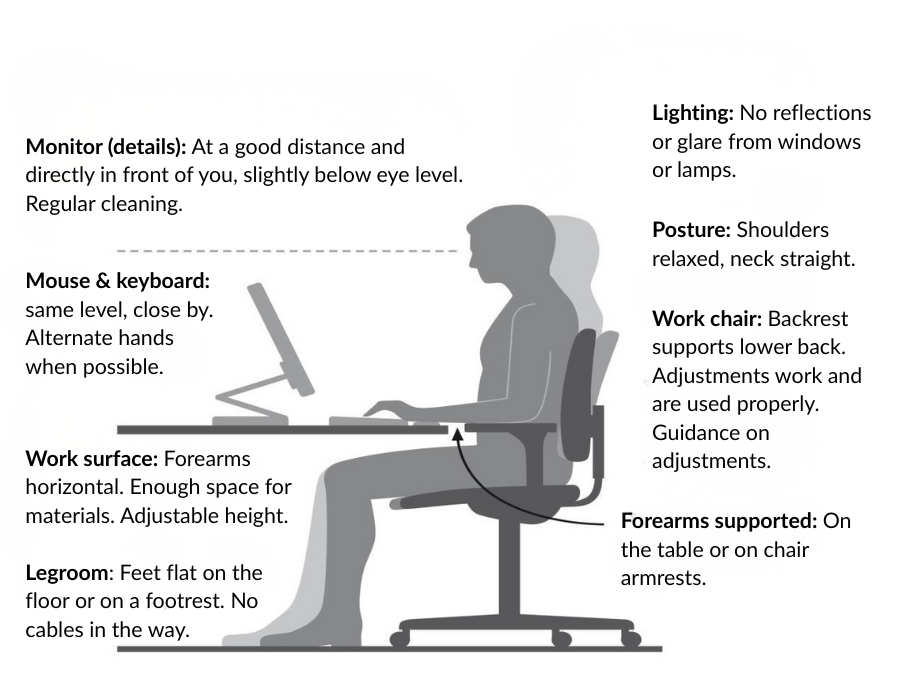
Key points for an ergonomics assessment include workstation setup and equipment placement (see picture below), workspace design such as having enough room to move and separating focused tasks from collaborative work, and healthy working habits like good posture, regular breaks, stretching, and changing position during the day.
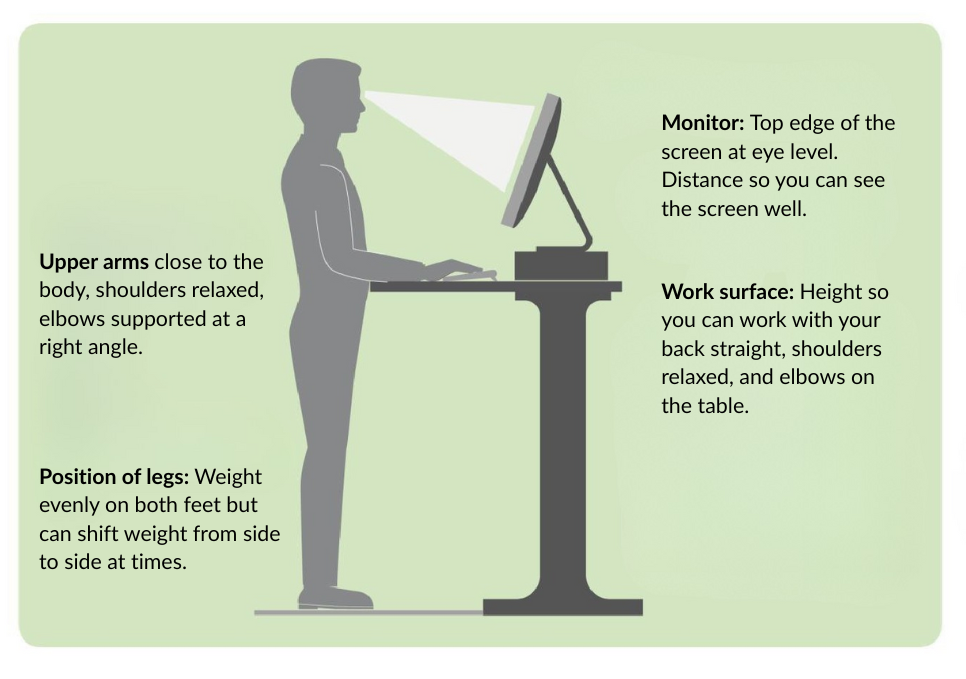
Tap or click to enlarge
Including ergonomics in your risk assessment helps prevent musculoskeletal disorders, vision problems, and repetitive strain injuries, making office work safer and more comfortable.
Useful tools and templates
Ergonomics assessment template (Moniheli)
A document that helps you review workstation setup, posture, equipment placement, and break habits. It guides you through the key elements of safe office work and makes it easier to document findings and improvement needs.
Work Wellbeing Survey (Artsi-opas.fi)
A practical questionnaire you can download and use to collect employees’ views on their work wellbeing. It helps identify issues like workload, stress, work atmosphere, and support at work. This is an unofficial English translation provided by Moniheli. In case of discrepancies, the original Finnish version applies.
Identifying the hazards of office work (ttk.fi)
A ready-to-use checklist for assessing risks in office work. It covers workstation ergonomics, lighting, noise, work postures, mental strain, and work organisation. It helps you document hazards, assess their seriousness, and plan concrete improvements in a structured way.
Hazard identification and risk assessment (ttk.fi)
Practical guidance on how to carry out a full risk assessment. The material includes explanations, examples, and checklists to help you identify hazards, evaluate risks, and plan preventive measures.
Risk Assessment Checklist
| Phase | What to do | Notes |
|---|---|---|
| Before starting | Ensure the policy and action programme exist; involve employees; assign responsible persons. | Participation helps identify real risks. |
| 1. Identify hazards | Review all tasks, tools, spaces, and work situations. | Include physical, chemical, biological, ergonomic, and mental strain factors. |
| 2. Evaluate risks | Assess likelihood and severity of harm; prioritise highest risks. | Helps decide where to act first. |
| 3. Plan preventive measures | Define actions, responsible persons, and deadlines. | Add them to the action programme. |
| 4. Document | Record results and actions in writing. | Keep documentation up to date. |
| 5. Monitor and update | Review regularly and after changes. | Continuous improvement is required by law. |
How to secure the right insurances for employees?
Workplace insurances protect your employees and your organisation. Employers must make sure that employees are insured for accidents, health risks, and other employment-related situations.
The most important insurances are:
- Tapaturmavakuutus – kattaa työssä sattuvat tapaturmat ja ammattitaudit
- Työntekijän eläkevakuutus (TyEL) – turvaa työntekijän eläkkeen ja sosiaalietuudet
- Työttömyysvakuutus – rahoittaa työttömyysetuuksia
- Ryhmätapaturma- ja henkivakuutus – voi olla pakollinen alasi työehtosopimuksen mukaan
These insurances protect both the employee and the employer in case of accidents, illness, or death. They are part of the employer’s duty to provide safe and secure working conditions.
How can equality be promoted and privacy protected at work?
How can equality be promoted at work?
Promoting equality at work means treating all employees fairly and respectfully. Everyone should have the same opportunities, regardless of gender, age, background, disability, religion, or other personal characteristics. Clear rules, open communication, and zero tolerance for discrimination help create a safer and inclusive workplace.
In Finland, the 🔗Equality Act and 🔗Non-Discrimination Act require employers to:
- Treat all employees fairly in recruitment, pay, tasks, training, career opportunities, and daily working conditions
- Prevent harassment and respond quickly if problems arise
- Actively promote equality and develop non-discriminatory practices for all employees
- Make reasonable accommodations for employees with disabilities, when needed, unless this causes a disproportionate burden for the employer (Non-Discrimination Act, Section 15)
a) What to do in practice?
To promote equality in a small organisation, you can take simple and practical steps:
- Create an Equality Promotion Plan
If your organisation regularly employs at least 30 people, you are legally required to prepare an equality plan. For smaller organisations, it is not mandatory but recommended. - Promote fairness in recruitment and everyday practices
Use objective and job-relevant criteria when recruiting. Avoid unnecessary personal questions. Respect employees’ privacy when handling personal data and sensitive information. Here is some guidance on inclusive recruitment: 🔗 How to promote diversity in recruitment? (ttl.fi) - Train staff and managers
Make sure managers and staff understand unconscious bias, respectful communication, and fair treatment. This helps turn policies into everyday practice. - Involve employees
Discuss equality issues together with staff or their representatives. Ask for feedback and ideas for improvement. - Provide reasonable accommodations
Employers must assess and implement reasonable accommodations for employees with disabilities. This can include changes to work tasks, working hours, tools, workspace, or support arrangements. Accommodations should be discussed together with the employee and reviewed when needed.
b) What is a workplace equality plan?
An equality plan is a written document that describes how an organisation actively promotes equality and prevents discrimination at work. It sets out the current situation, identifies areas for improvement, and lists concrete measures to ensure fair treatment in recruitment, pay, tasks, training, career opportunities, and everyday working conditions.
In Finland, workplaces with regularly at least 30 employees are required by law to have an equality plan.
The mandatory parts of the plan are:
- a report on the equality situation in the workplace
Equality survey for workplaces - ttk.fi
A practical questionnaire that helps employers assess how well equality and non-discrimination are realised in their organisation.
- a salary survey: used to ensure that there are no unjustified pay differences between employees performing the same or work of equal value.
- measures to promote equality: concretes and realistic, with a schedule for the implementation, and it should be decided which parties are responsible for the measures.
- an assessment of the implementation of previous measures (This evaluation also serves as a template for the following year’s plan and is used to monitor implementation of the plan).
Useful guides and tools
Drafting an equality plan – Tasa-arvo.fi
A guide that explains step by step how to create a written equality plan for your workplace. It covers what information to include, how to assess current equality, and how to plan concrete measures to prevent discrimination.
Equality checklist for the workplace – thl.fi (in Finnish)
A practical checklist to help employers review and monitor equality in their workplace. It includes points on recruitment, pay, tasks, training, career opportunities, and everyday work practices to ensure fair treatment for all employees.
c) Practical ways to strengthen equality and inclusion
Beyond policies and equality plans, associations can use additional tools to make their events and workplaces more inclusive. These approaches help ensure that everyone feels respected, heard, and able to participate fully.
Safer Space Principles
Safer space principles help create an environment where everyone feels respected and supported. They set clear expectations for behaviour, prevent harassment, and provide guidance for responding to problems.
Applying these principles ensures that events, meetings, and workspaces are inclusive, welcoming, and safe for all participants.
A safer space policy should include:
- Rules for respectful behaviour
- Guidance on confidentiality and privacy
- Instructions for reporting harassment or discrimination
- Clear consequences for violations
Language Strategy
A language strategy ensures clear and inclusive communication in multicultural associations. It supports participation by everyone, respects everyone’s language skills, and reduces misunderstandings.
Writing down guidelines makes inclusion actionable and helps all members feel valued.
A language strategy should include:
- The association’s working languages
- Rules for translating key documents
- Communication practices for meetings and events
- Support for language learning
- Guidance for volunteers and staff
How can privacy be protected at work?
Protecting privacy at work means handling personal data carefully and only collecting information that is truly needed for the job. Employee data must be stored securely and shared only with authorised people. Employees have the right to know what information is collected about them and how it is used.
Provisions protecting the personal data of employees are given in the 🔗Act on the Protection of Privacy in Working Life.
Good practices for privacy include:
- Keeping clear rules for data protection and confidential handling of sensitive information.
- Training staff to respect privacy in everyday work.
- Limiting data collection to what is strictly necessary and delete it once it is no longer needed.
- Ensuring employees know their rights regarding privacy.
a) Respecting privacy at work
Both employees’ fundamental rights and the employer’s rights are important. An employer’s rights do not override employees’ rights to secrecy of correspondence or privacy in data processing. Understanding these rights creates a firm basis for smooth cooperation.
Work tools and duties of care
Work-related tools, including email, are protected by privacy laws. The employer cannot access or inspect personal messages without valid legal grounds. Even if these tools are meant only for work, the employer may access them only in clearly justified situations and to a limited extent.
If, for instance, emails must be accessed while an employee is absent, the employer should first:
- Offer options such as out-of-office replies, forwarding messages to approved contacts.
- Obtain consent when required
- Limit access to emails strictly needed for continuity of work or legal obligations
Data Protection in Electronic Communications
🔗The Act on Electronic Communications Services indicates that messaging data (e.g., data volumes, network info) can sometimes be processed, but the content of emails cannot be accessed without proper grounds. Even in cases of misuse, data must be handled carefully to protect confidentiality and privacy.
b) Handling Personal Data and Risk Assessment
The employer may only process personal data necessary for the employment relationship. Outdated, incorrect, or unnecessary data must not be kept. Employees should normally provide their own data; consent is needed if the employer collects it elsewhere, except when required by law.
Employees have rights under the 🔗General Data Protection Regulation (GDPR) to:
- Be informed about the processing of their data
- Access, correct, or delete their data
- Restrict, move, or object to the use of their data
Privacy in Risk Assessments
Collecting personal health data (e.g., fitness for certain tasks) is necessary for legally required risk assessments. This data must be treated as confidential, recorded anonymously where possible, and shared only with the occupational health provider and responsible manager.
It should be stored securely and used solely for work-related purposes. Data collection should be limited to what is strictly necessary and deleted once it is no longer needed.
Integrating equality and privacy into risk assessments ensures that the process is inclusive and respects employee rights, while supporting legal compliance and a safe workplace.
Impact Assessments for Data Processing
Associations must carry out data protection impact assessments when planned data processing may pose high risks to individuals’ rights and freedoms. This includes processing:
- Health data or sensitive personal information
- Large-scale data on employees
- Automated decision-making affecting employees
- Systematic monitoring of publicly accessible areas
Impact assessments help identify and manage risks, assess necessity and proportionality, and ensure compliance with data protection regulations. They should be carried out before processing begins and updated whenever circumstances change, such as new technologies, changes in the type of data processed, or new recipients of the data.
You should document the assessment and seek advice from a data protection officer if available. Multiple processing operations may be assessed together if similar, and individual operations must be reassessed if risks change.
Protecting personal data and integrating privacy into risk assessments strengthens trust, inclusion, and well-being in your association. It ensures a fair, safe, and legally compliant workplace, helping avoid risks related to discrimination or data breaches.
Want to know more?
🔗Privacy protection (Työsuojelu.fi)
🔗Employee rights and privacy protection (Yrittäjät.fi)
🔗FAQ about working life - Information about processing the employee's data, locating and monitoring the use of internet (Tietosuoja.fi)
🔗For organisations: Know your responsibility and build trust (Tietosuoja.fi)
What to do when an employment relationship ends?
On what grounds can employment be terminated?
An employment relationship can end in different ways. The legal requirements depend on the situation.
| Situation | Reason(s) | Notice period |
| The employee resigns | No reason required | Yes |
| Employer dismissal (permanent contract) | Proper and weighty reason required | Yes |
| Trial period termination | Can be terminated by either party. No proper and weighty reason required but must not be discriminatory or inappropriate. | No |
| Cancellation without notice | Extremely serious breach | No |
Note: A fixed-term contract ends automatically on the agreed end date.
It cannot usually be terminated with notice before that date unless:
- the contract explicitly allows termination during the fixed term,
- both parties agree to end the contract early, or
- there are grounds for cancellation without notice.
More information: 🔗Reasons for termination of employment (Suomi.fi)
a) The employee resigns
An employee may terminate the employment relationship by notifying the employer.
The resignation does not need to be justified.
The employee must respect the applicable notice period, defined in the collective agreement or the 🔗Employment Contracts Act .
b) Employer dismissal (permanent contract)
If the employer terminates a permanent employment contract, there must be a proper and weighty reason. There are two main categories:
- Personal reasons, such as serious breach of duties, repeated negligence, unjustified absence, inappropriate behaviour, or inability to perform work.
- Financial and production-related reasons, such as a genuine and permanent reduction of work or organisational restructuring, and no other suitable work can be offered, or the employee cannot reasonably be trained for other tasks.
The following do not constitute valid grounds for dismissal: the employee’s illness, pregnancy, or participation in industrial action, or other discriminatory reasons.
Before dismissal, you, as an employer, must:
- Hear the employee and give them an opportunity to present their view
Note: the employee has the right to invite an assistant or counsel for the hearing - In case of personal grounds, first issue a warning and give the employee an opportunity to correct their conduct
- Assess whether other suitable work can be offered
- Ensure that the dismissal is not discriminatory
Deliver the notice to the employee in person. If this is not possible, the notice may be sent by mail or e-mail.
Ensure proof of delivery. The employment relationship ends after the applicable period of notice.
Notice to terminate an employment relationship – Työsuojelu.fi (in Finnish)
It is good practice to provide a written notice of termination. Use this occupational safety and health administration form to give notice.
c) Trial period termination
During the trial period, either party may terminate the employment relationship without a proper and weighty reason.
However, termination must not be based on discriminatory or otherwise inappropriate grounds. The employee must also be given the opportunity to be heard regarding the grounds for termination.
No notice period applies during the trial period.
d) Cancellation without notice
An employment contract may be cancelled with immediate effect only for extremely serious reasons, such as a serious breach or neglect of a fundamental duty of employment.
The right to cancel must be exercised within 14 days of becoming aware of the grounds. When cancelled, the employment relationship ends immediately without a notice period.
NOTE: Lay-off
A lay-off means that the employer temporarily suspends work and wages payment while the employment contract continues.
Työsopimus pysyy kuitenkin voimassa.
An employer can decide to lay people off alone, or the employer and employees can jointly agree on lay-offs.
→ Read more: 🔗Lay-offs (Yrittäjät.fi)
What is a notice period and how long is it?
A notice period (irtisanomisaika) is the time between giving notice and the actual end of the employment relationship. During this period, the employment relationship continues normally and both parties must fulfil their obligations.
In most sectors, notice periods are defined in the collective agreement.
The collective agreement must always be checked first.
If no collective agreement applies, notice periods are defined by the Employment Contracts Act.
According to the Employment Contracts Act:
| When the employer dismisses an employee | When the employee resigns | ||
| Length of employment | Notice period | Length of employment | Notice period |
| 0–1 year 1–4 years 4–8 years 8–12 years Over 12 years | 14 days 1 month 2 months 4 months 6 months | Up to 5 years Over 5 years | 14 days 1 month |
What must the employer do when employment ends?
a) Pay final salary correctly and on time
When employment ends, all employment-derived receivables must be paid in the final salary. These may include:
- Wages
- Evening and other supplements
- Overtime pay
- Holiday pay and unused holiday compensation
- Holiday bonuses
- Daily allowances and travel reimbursements
- Performance or other bonuses
The final salary must be paid:
- On the date agreed in the employment contract, or
- On the last day of employment if no date has been agreed
If payment is delayed, the employee may be entitled to waiting period pay, up to six calendar days, and default interest.
b) Provide a wage certificate if needed for unemployment benefits
If the employee applies for unemployment benefits, they may need a wage certificate. Under the law, the employer must provide it on request. The wage certificate is not the same as a payslip.
It must include:
- Wage income for 26 calendar weeks
- Weekly working hours if they vary
- Unpaid periods and reasons
- Holiday pay and bonuses
The certificate must be submitted to:
- The employee’s unemployment fund, or
- Kela, if the employee is not a member of a fund
c) Provide a certificate of employment upon request
An employee is entitled to receive a written certificate of employment (työtodistus) upon request. The employer must issue it without undue delay.
The employee may request it within 10 years of the end of employment. For this reason, employers must store information on employment duration and job duties for at least 10 years.
There are two types of certificates:
- Brief certificate, containing the duration of employment and job duties
- Extended certificate, with the duration of employment, job duties, reason for termination and testimonial. The employer does not include the reason for termination or a testimonial unless the employee specifically requests it.
Neglecting to issue a certificate of employment may result in a fine under the Employment Contracts Act.
Practical tools
Certificate of employment template – Moniheli (Word)
Ready-made Word template for drafting a certificate of employment. Includes models for both brief and extended certificates.
Certificate of employment – Työsuojelu.fi (pdf)
Official form from the Occupational Safety and Health Administration for issuing a certificate of employment. The form is available in Finnish.
d) Notify authorities and retain required records
When employment ends, the employer has to:
- Inform payroll administration
- Notify the Finnish Immigration Service of the end of employment, if the employee is a non-EU/EEA/Swiss citizen working with a residence permit.
Also, certain employment-related records must also be retained after termination, for example:
- Payroll records, 10 years
- Employment duration and duties, 10 years
- Working time records, 2 years
- Annual holiday records, 2 years
Records must be stored in accordance with the General Data Protection Regulation. Information that is not legally required must not be retained.
How to ensure a smooth handover when employment ends?
In addition to legal obligations, organisations should plan the practical end of employment carefully.
In many associations, staff turnover can be frequent due to fixed-term contracts and project-based work. Without clear handover processes, important knowledge, access rights, and documents may be lost.
A structured offboarding process helps:
- Maintain continuity
- Protect sensitive information
- Ensure projects and reporting continue smoothly
The checklist below helps you manage the offboarding process smoothly.