
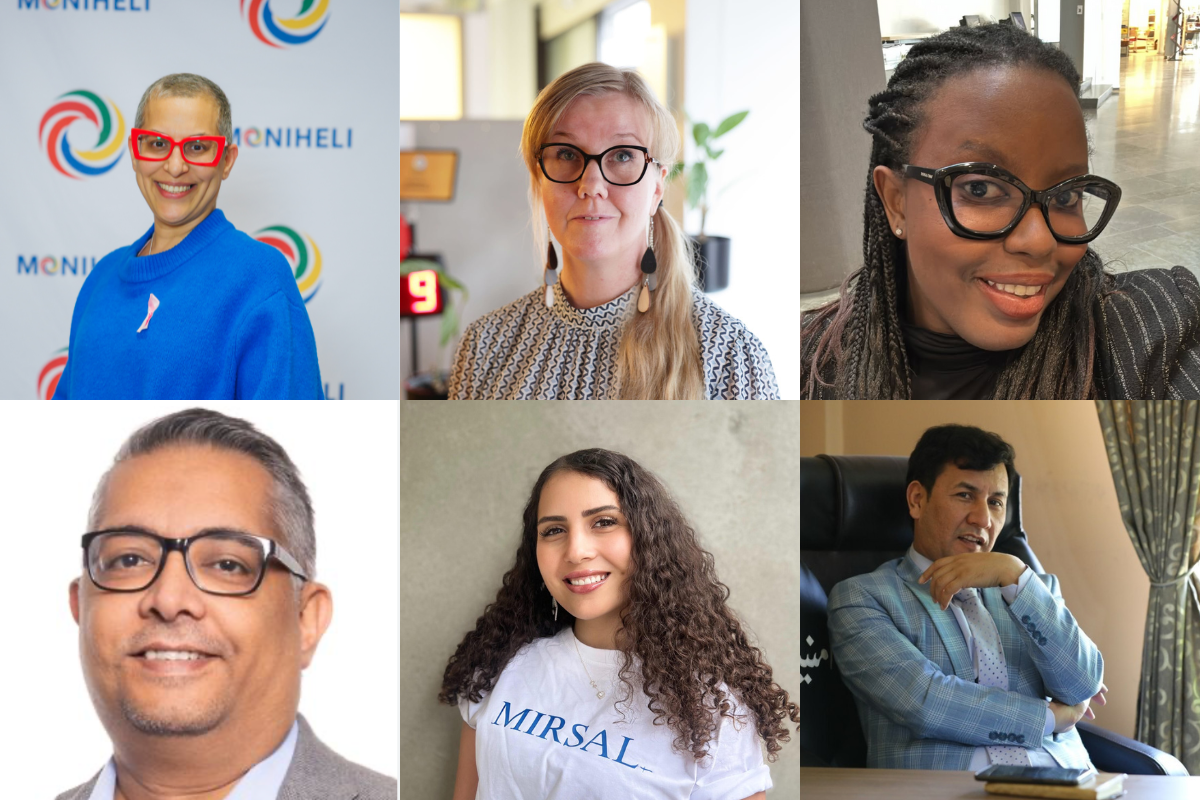
Moniheli's Autumn General Assembly will be held on Saturday, November 22. In the assembly, five full members and one deputy member will be elected to the Board. The new members will complement the Board, which consists of the Chairperson and eight other members. Of the five full members, four will be elected for a two-year term and one for a one-year term.
Continuing on the Board in 2026 are Pia Groenewolt, Harshwardhan Saini and Johanna Wirkkala. You can read their introductions here.
The Election Committee, appointed at Moniheli’s Spring General Assembly 2025, has reviewed the candidates who applied for Moniheli’s positions of trust and proposes the following members for the Board.
As full members:
Nora Dadi
Nora Dadi is an experienced NGO and community professional with strong leadership skills and extensive experience in multicultural family and community work. She has served on the boards of Moniheli, the Central Union for Child Welfare, and Kaapatut Lapset ry. At Familia ry, she leads the peer-support team, coordinates anti-racism training in multicultural environments, and fosters intercultural interaction through family counselling.
In her work, Nora emphasizes creating a safe and open environment for dialogue, where different perspectives are heard. Her experience in developing peer activities, intercultural family work and multilingual community initiatives will be valuable in the future work of Moniheli’s board.
Nora sees Moniheli primarily as a voice amplifier and bridge builder between multicultural communities and public authorities. She emphasizes collaboration, equality, and participation, and aims to strengthen the ability of immigrant communities to influence society. She is particularly committed to advancing equitable participation and ensuring that marginalized voices are heard at all levels of Moniheli’s work.
Kristina Kemi
Kristina Kemi is an expert in integration, inclusion, and employment with extensive experience in cross-sector collaboration. She has served as an expert member of the Tampere Immigrant Council, in the Association Network of Pirkanmaa, and in several leadership positions across NGOs and housing associations.
Her areas of expertise include strategic leadership, HR management, and project administration. Kristina played a key role in founding International House Tampere and developed collaborative management models in Helsinki’s employment services.
Kristina envisions Moniheli as a strong umbrella organisation that coordinates cooperation, develops new funding and impact models, and ensures the long-term vitality of civil society networks. She wants to help build an even more agile and strategically effective Moniheli network that supports the collective voice and resilience of member associations.
Morine Hawa Sesay
Hawa Sesay is an active social advocate with broad experience representing youth and multicultural communities. She serves on the board of the Finnish-Africa Society, chairs the Kokkola Multicultural Council, and represents youth in the Ministry of Justice’s Advisory Board for Ethnic Relations. She has also served as Vice-Chair of UN Youth Finland and President of Leo Club Chydenius.
Hawa brings to Moniheli strong networking skills, technical competence, and creative insight. She has experience in both national and international collaboration and in youth advocacy from grassroots to ministerial levels.
She views Moniheli as a bridge between communities and authorities. According to Hawa, Moniheli’s role is to increase understanding, support grassroots associations, and strengthen participation so that everyone has the opportunity to be heard and take part in Finnish society. Moniheli also fosters dialogue and understanding among people from diverse backgrounds.
Nagendra Singh
Nagendra Singh is an experienced professional in integration, employment services, and community leadership, with over a decade of experience in NGOs, education, and advocacy work. He serves on the board of Omnia, the Espoo Advisory Board on Integration, and within the boards of local Social Democratic Party associations.
Nagendra on edistänyt yhdenvertaisuutta ja osallisuutta niin politiikassa kuin järjestökentällä, ja hänellä on vahva asiantuntemus maahanmuuttajien koulutuksesta, työllistymisestä ja yhteisöjen kehittämisestä. Hän on myös rakentanut yhteistyötä eri taustaisten yhteisöjen ja viranomaisten välille sekä tukenut uusia kotoutumista tukevia verkostoja ja hankkeita.
He views Moniheli as a unifying and catalytic force that strengthens democracy, tackles discrimination, and helps member associations grow sustainably. He wants to help Moniheli become an even stronger social advocate that positions diversity as Finland’s collective strength.
Sandra Tutah
Sandra Tutah is the founder and Executive Director of Mirsal ry, with extensive experience in NGO leadership and intercultural cooperation. She previously served four years on Moniheli’s board, including as secretary, and coordinates the Anna Lindh Foundation’s Finnish network through Mirsal.
Sandra's expertise includes project and financial management, youth collaboration, and marketing. She has extensive experience empowering communities, particularly within the Arabic-speaking population, and has built partnerships that foster inclusion and intercultural understanding.
Sandra sees Moniheli as a key voice representing multicultural communities and supporting their work in promoting equality and participation. She believes Moniheli can serve as a strong national advocate for multiculturalism — an organisation that connects communities, supports NGOs, and promotes equality, participation, and social cohesion in Finland. Sandra also sees Moniheli as a facilitator of collaboration between immigrant communities and Finnish society and as a force that strengthens diversity as a societal resource.
As a deputy member:
Mohammad Latif Fayaz
Latif Fayaz is the Director of the Finnish Hazara Cultural Association and has been actively involved in social and cultural work for nearly two decades. He has worked as his country’s representative at NATO’s office in Afghanistan and with the UN Assistance Mission in Afghanistan, and has served as a university lecturer and parliamentary candidate in Kabul.
Latif brings to Moniheli a broad international perspective and experience in NGO leadership and multicultural collaboration. He has participated in Moniheli’s municipal and regional election projects and recognizes the organisation’s role as a bridge between communities and authorities, and as a promoter of equality and inclusion.
He sees Moniheli as a key platform for dialogue, rights awareness, and cooperation — one that can lead civil society’s efforts to advance equality, welfare, and the fight against discrimination. According to Latif, Moniheli can strengthen civil society’s voice, raise awareness of immigrant community rights, and serve as an example of how collaboration creates well-being, inclusion, and social cohesion.