

Moniheli ry’s expert statement to the Administration Committee, Government Proposal HE 54/2026 vp
Moniheli ry thanks the Administration Committee for the opportunity to provide a statement on Government Proposal HE 54/2026 vp. The proposal would introduce a new civic knowledge requirement into the Finnish Citizenship Act. As a rule, this requirement would be demonstrated by passing a citizenship test. The citizenship test would primarily be a digital multiple-choice test assessing the applicant’s knowledge of the functioning of Finnish society and of the rights and obligations of the individual.
Based on research evidence, the impact of citizenship tests and other conditions for obtaining citizenship on integration is not unambiguously positive, as also indicated by MIPEX, among others. A citizenship test does not therefore automatically promote integration. The content, implementation and monitoring of the test must be designed so that the test supports the purpose of the law and does not become an unnecessary or wrongly targeted barrier.
Comments on the structure and content of the citizenship test
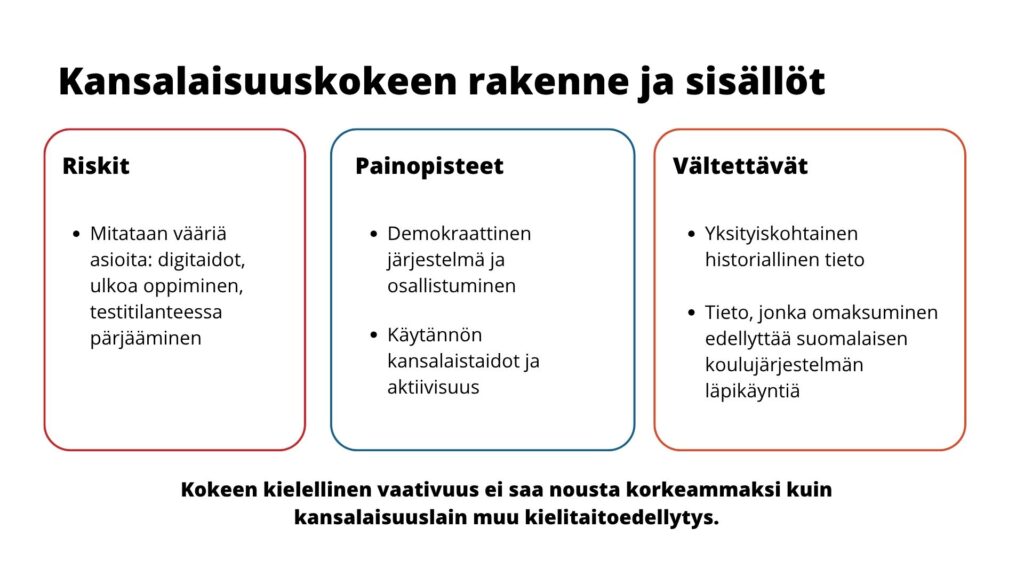
A system based on a digital multiple-choice test involves a risk that, over time, the questions and correct answers will begin to circulate unofficially in public. Preparation may then become focused on mechanical memorisation. This does not yet demonstrate that the applicant understands, for example, the practical significance of Parliament, taxation, equality or freedom of association, or knows how to function in Finnish society.
The content of the citizenship test should therefore focus on practical civic knowledge: understanding rights and obligations, the duties of public authorities, equality, the basic rules of working life, the everyday service system, and the democratic system and forms of participation. From the perspective of integration, it is essential that the applicant understands how they can participate in society and influence matters that concern them.
The test should not emphasise detailed historical, cultural or institutional knowledge that cannot reasonably be expected of all current Finnish citizens either, and whose acquisition in practice requires having gone through the Finnish school system. The questions must be in plain language, non-discriminatory and proportionate to the language proficiency requirement for citizenship. The linguistic difficulty of the test must not in practice exceed the other language proficiency requirement set under the Citizenship Act.
Acquiring civic knowledge
Civic knowledge should not be understood only as a formal test performance. It is also accumulated in working life, family life, dealings with public authorities, voluntary activities, positions of trust, resident activities and civil society organisations. In particular, participation in civil society organisations can strengthen knowledge related to democratic participation, freedom of association, ways of influencing society, equality and cooperation with public authorities.
Moniheli therefore proposes that reliably documented participation in civil society could in the future be recognised as a way of demonstrating civic knowledge alongside the citizenship test and formal qualifications. This would not be exceptional in a European comparison: in Austria, long-term voluntary work or service in a position of trust in a non-profit organisation can, under certain conditions, support accelerated naturalisation, and in Belgium the requirements for citizenship may include participation in the life of the receiving community.
Preparation of the questions
Moniheli considers it important that the preparation of the citizenship test questions, learning material and assessment criteria be transparent and based on broad expertise. Immigrants, people who have already obtained Finnish citizenship, and organisations representing them should also be consulted in the preparation process so that the language, accessibility, difficulty level and substantive relevance of the questions can be assessed from the perspective of the people whom the test concerns.
According to the proposal, the citizenship test learning material would be prepared on the basis of the civic orientation learning material. Applicants must be able to trust that the publicly available learning material and the contents of civic orientation cover everything that may be asked in the test.
Equality and legal protection
Open learning material alone is not sufficient to ensure equal opportunities to prepare for the test. Since citizenship is in practice applied for only years after the end of the integration programme, access to civic orientation or equivalent citizenship test preparation training should also be made possible for those outside integration services, such as employed people, students and people who have moved to Finland on the basis of family ties. Municipalities should have the possibility to offer this training also to people who are not covered by the integration programme, if necessary for example for a reasonable fee.
At the level of the Act, or at least in the Committee’s report, attention should also be paid to issues affecting legal protection in relation to the test. These include the possible fee for the test and the overall cost of applying for citizenship, opportunities to retake the test, regional availability and national consistency, special arrangements, reasonable accommodations, the required pass level and monitoring of the test’s impacts. Moniheli does not consider it sufficient that decisions affecting the real possibilities of obtaining citizenship are left entirely to later implementation without clear principles safeguarding equality.
Moniheli proposes that the Administration Committee require, as part of monitoring the impacts of the law, an assessment of whether the citizenship test in practice measures civic knowledge or other abilities, such as written language skills, digital skills and test-taking strategy. Monitoring should examine, by applicant group, whether the test becomes an obstacle for people who have real experience and knowledge of functioning in Finnish society but weaker conditions for succeeding in a digital, test-based assessment. At the same time, the possibility of broadening the ways of demonstrating civic knowledge in the future should be assessed, including documented civic participation, civil society activity, voluntary work and other forms of active citizenship.
Concrete proposals for amendments
- The list concerning the content of the citizenship test in section 25 a of the Citizenship Act should be supplemented by adding the functioning of the democratic system and forms of democratic participation. This would ensure that the test also measures knowledge related to the individual’s social participation and opportunities to influence society.
- Section 25 c of the Citizenship Act, or at least the Committee’s report, should be specified so that the citizenship test learning material, questions and answer options are assessed for their appropriateness from the perspective of the target group.
Moniheli ry