
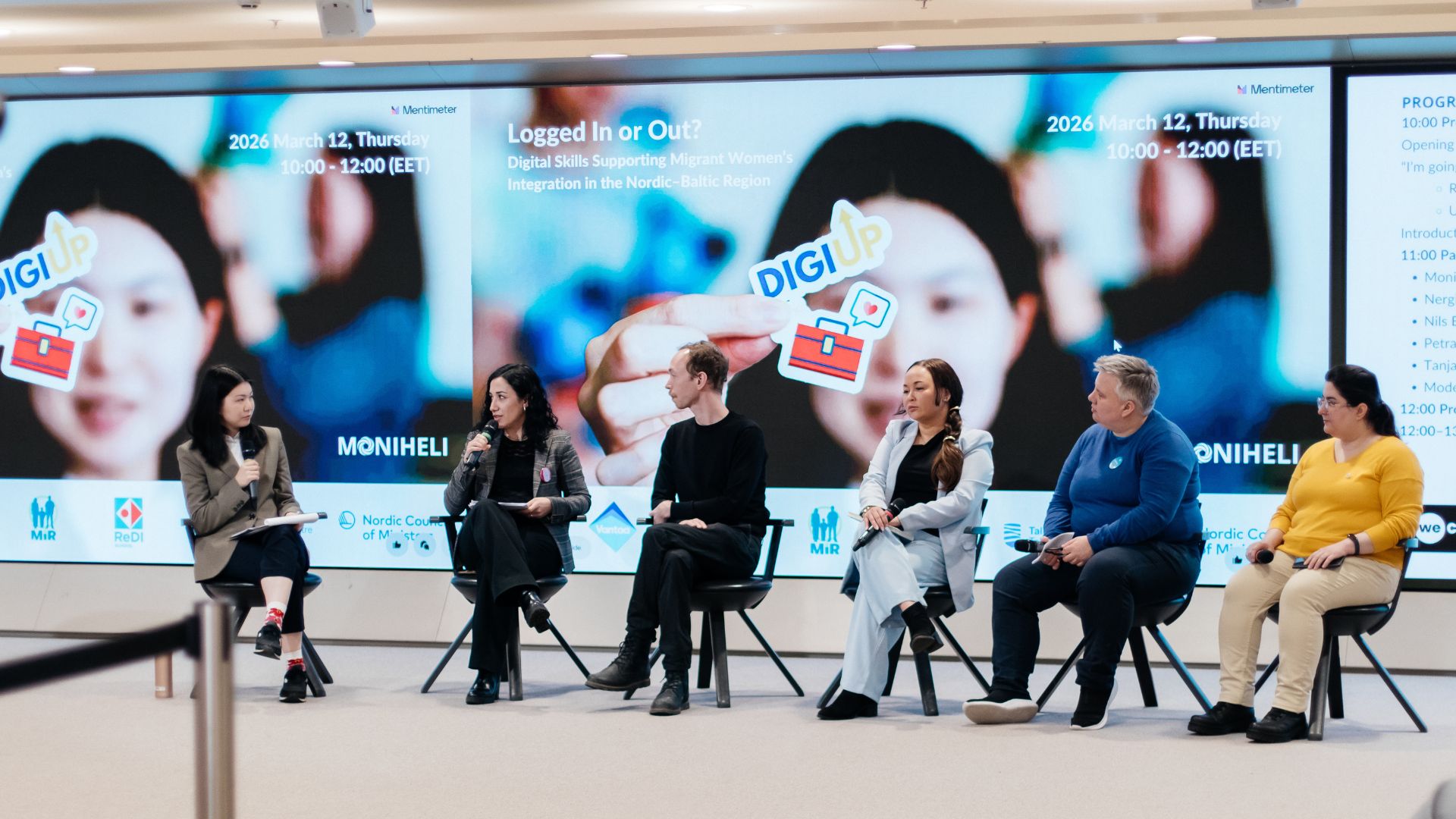
The final seminar of the DigiUp Toolbox project, funded by the Nordic Council of Ministers, was held on March 12 in Helsinki. It brought together trainers, researchers, and practitioners from across the Nordic and Baltic regions to reflect on what has been achieved and what still needs to change.
At its core, the DigiUp Toolbox project aims to strengthen the digital skills of migrant women and support trainers, educators, and community members in delivering inclusive digital skills training. By improving women’s skills and confidence, the project enhances employment opportunities and social inclusion, contributing to a more sustainable and integrated Nordic region.
Toolbox project work
Since March 2025, the project has focused on co-creating a practical, multilingual toolbox for educators working with migrant women. The toolbox brings together tested training methods and approaches developed across Denmark, Estonia, Finland, and Norway.
The work has highlighted a key insight: digital skills are not only technical. They are deeply connected to confidence, trust, and understanding how systems work.
During the seminar, trainers shared that many participants already had basic digital knowledge but lacked the confidence to use it in real-life situations, such as job searching or navigating services. Training sessions, therefore, became safe learning environments rather than just skill-building spaces; they also fostered peer support, community, and motivation.
Our work still continues
The discussions made it clear that promoting digital inclusion requires moving beyond access alone.
Several challenges were identified:
- Systems designed for “ideal users” often exclude people who are unfamiliar with local bureaucracy or digital norms, highlighting the need to develop systems with users, not for them.
- Short-term projects risk creating “project graveyards” without long-term continuity.
- Lack of trust, both in institutions and digital environments, affects engagement; creating low-threshold participation opportunities and safe environments is key.
- Placing too much responsibility on individuals does not support people in learning or using digital tools.
At the same time, the seminar pointed toward concrete directions for the future:
- Strengthening roles of intermediaries such as NGOs and peer trainers who help people navigate systems.
- Recognising informal support networks (“warm experts”) and building on them.
- Focusing on confidence and relevance to learners, not only skills.
- Designing services for real users, not assumed ones.
- Supporting long-term participation, rather than short-term engagement.
One recurring theme was trust. Access to services does not automatically lead to trust in them. Building trust requires continuous interaction, understanding, and support.
Another key message was the importance of individual starting points. Each learner’s path is different, and effective support must reflect that.
Toolbox as a starting point for promoting further digital inclusion and integration
The DigiUp Toolbox is now available as an open resource for educators, trainers, and organisations working on digital inclusion.
It offers practical tools, training models, and approaches that can be adapted to different contexts and learner groups. The toolbox will continue to be developed beyond the project through the DigiUp programme at Moniheli.
If you have, or know of, materials that fit with the toolbox’s themes, don’t hesitate to share them with us. Only together can we ensure relevant and effective content for Nordic and Baltic stakeholders.
The text was written and translated with the help of ChatGPT and reviewed by experts.
More information:
Link to the presentation slides
Contact information

Yuri Kitaba
Project Manager
+358 (0)50 375 1203
yuri.kitaba@moniheli.fi
Suomi, English,
日本語 (japani)