
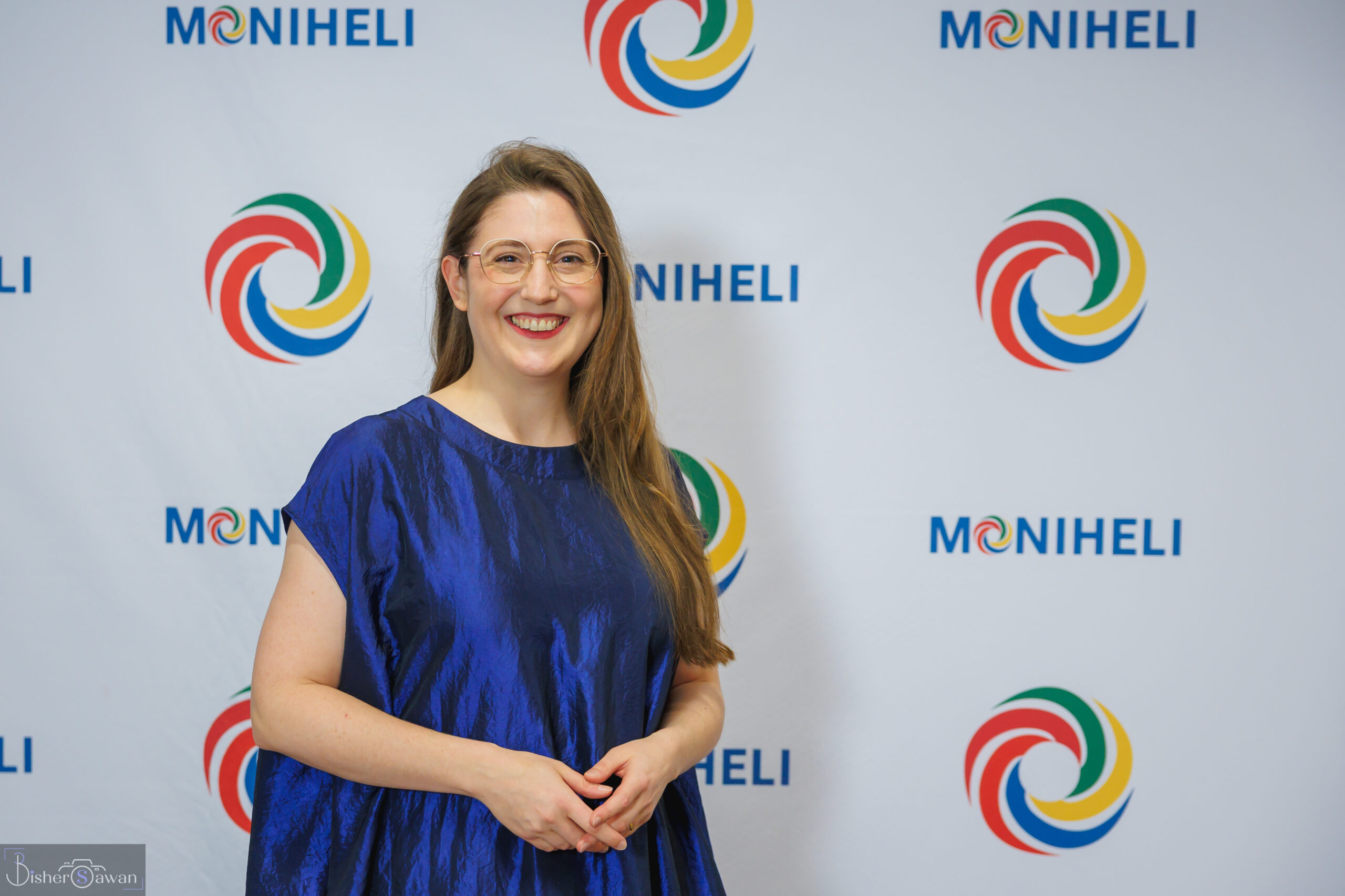
For the past fifteen years, Moniheli has strived to carry forward the voices of Finland’s migrant communities to ensure that their members would have the same chances at having a good life as other residents in Finland, and to inspire in its members the motivation to make change, even when facing challenges.
As we are finalising our updated strategy, I went back to read the first strategic objectives for Moniheli, written in 2012. (Amazing, what you can find on the internet these days!)
As ambitious as those objectives sounded back then, I was surprised to realise that some of them have actually been achieved, at least in part, or are goals we are now actively moving toward.
They included:
”Moniheli develops and grows as an employer, employing up to 30 persons by 2020.”
We may have missed that by a few people, but we still grew from a team of two to a team of ten - and more, counting leading specialists in their fields.
Another was:
”Moniheli becomes a national association uniting all migrant and multicultural associations in Finland.”
Again, maybe not all, but we are now 170 members strong from across the country, from the thirty founding associations in the capital region who came together in 2010 to establish this network, some of which are here with us today.
And then there was:
”Moniheli has its own house or building, as well as its own research and development institute.”
Well - we haven’t quite purchased our own building yet. But now our home is here, in Kalliola Setlementtitalo. A home we share with like-minded organisations, and a place where we hope Moniheli’s members and friends will feel at home too, and make their own.
We have not founded our own research institute either, but this year we took a decisive step toward research cooperation, notably through multi-university projects funded by the Strategic Research Council. One of them, named OBaMa (for Overcoming Barriers to Participation), aims to co-create with our network’s practitioners solutions to inequalities in democratic participation.
This theme is written in our DNA since our first EU-funded projects like iCount, through our cooperation with the Ministry of Justice and with ETNO, and in our ongoing work to promote the political participation of immigrants.
We have done this, and much more, over the past fifteen years.
We have supported migrant parents in guiding their children toward secondary education.
We have delegated close to 800,000 euros in small grants to our members’ projects.
We have helped hundreds of migrants and families find housing, preventing homelessness.
We have planted hundreds of trees across municipalities.
We have organised election panels where migrants were not just a topic on the agenda but participants and candidates themselves.
We have trained professionals from municipalities, from housing services, from schools.
And yes: we have also argued, disagreed, tried things that didn’t work, underestimated how much work something would take, or overestimated how much we could humanly do.
We are all just humans.
But most of all, we have trained, advised, supported and encouraged hundreds of actors, other humans, in the multicultural civil society.
Because while Moniheli as an organisation has its own goals, there would be no Moniheli without the community of actors in our member associations: the true power behind change.
Every single person who decides to band together with others for the good of their community and of society contributes to the story we celebrate today.
This network has grown stronger.
In recent years, many associations have taken a major step toward professionalisation with over fifteen members receiving their first multi-year project funding, primarily through STEA.
With this support, and with staff who can dedicate time to their work instead of volunteering on top of their own life, minority organisations have shown what they can do: developing models to promote health and wellbeing, combining cultural and linguistic competence with professional expertise.
As we all know, the conditions that made this possible are now changing. With national project funding for social and health associations facing major cuts in the years to come.
We can only hope that through their growth, these associations have built strong enough partnerships, and developed good practices, to sustain their impactful work in the future.
We will do our best at Moniheli to contribute to this.
I’ve been asked if associations in our network are panicking about the STEA cuts.
Sometimes I’ve wondered if they’re panicking enough.
But if you think about it, it’s not all that surprising.
After all, we migrants are professionals of reinventing ourselves.
We are experts in starting anew.
This is not the first time we’ve had to face the unknown, question our certainties, or watch the ground under our feet crumble.
I say this as a person, a white person, who moved here from Western Europe to study.
But among us are people who have survived war, faced torture and abuse;
people who have crossed mountains, forests and seas to reach this land;
people who have had to start their professional lives again from scratch, who have to justify again and again their competence - or simply that they are here, and that they belong.
So we will continue. On our way, we may crash, we may fall, and that’s the least we can expect.
But we will pick ourselves, and each other, up.
We will find strength in the support of others.
That is why I believe in the resilience of our community and network.
Truly though, all the good will in this corner of Finland’s civil society will be needed in the years ahead.
Across Europe, we are witnessing the rise of the illiberal extreme right - riding on anti-immigration rhetoric, stoking fear and hate against minorities, and in some countries curtailing the media and the work of civil society.
It would be easy to think that Finland is above all this; that its past in defending human rights, freedoms and peace will automatically define its path in the future.
Yet even here, we see how ideas that once felt like a given part of Finland’s identity have shifted in only a few years; Finland as a world leader in education, a technological frontrunner, a country with a strong welfare system.
This can only remind us that the freedoms and rights we benefit from in this country are not carved in stone.
They live only as long as people choose to uphold them: by speaking out, and by acting together. This includes the small, but growing number of migrants who take part in politics - as voters, as candidates, and as elected representatives shaping the future of their cities.
In a time where democracy and justice are questioned even among our historical allies, where civilians - also families and friends of the communities that make our network - are killed under bombs or subject to starvation, we must cherish these values and freedoms we have access to, and make the most of our privilege by putting them to use.
This is the work that our associations – also the smallest ones – do every day: creating community, giving voice to those unheard, ensuring that no one is left outside the democratic conversation.
We are thankfully not alone in this endeavour, or we would not have a chance to succeed. We have allies in this society. Not defined by their origin, or their language, but by their shared commitment to a Finland that remains open, fair, and humane, which they uphold across many sectors and levels of governance - from partner organisations to municipalities and the ministries.
That is why cooperation is not just a word on paper for Moniheli but a principle we live by every day.
Our strength is not only in diversity, but also in community.
By understanding diversity, and our own position and power in it, we build the foundation for true democracy, where all have an equal chance to be heard, to be actors of their own fate, and contribute to our society. We empower ourselves and others to make these steps towards active citizenship, so that everyone, regardless of their background, has a fair chance to live a good life, to belong, and to thrive here in Finland.
So here’s to the first fifteen years of Moniheli and to the next fifteen, where we continue building the future of Finland.