
Organisational advisory boards
The cooperation between with non-governmental organisations is on different levels across wellbeing services counties in Finland (2).
Very typically there are various NGO networks, and the advisory boards of NGOs Organisational advisory boards
NGOs are divided into thematic networks based on their profile, e.g. substance abuse and mental health, children and families, youths, employment, elderly people, disabilities, patients’ organisations, sports etc.
In the wellbeing services counties with many foreign-born populations (e.g. Vantaa and Kerava), the multicultural organisations have their own thematic network. In other wellbeing counties, they are usually part of “multidisciplinary or other theme” networks (e.g. Keski-Uusimaa).
Representatives of NGOs can apply to be selected as members of the NGO advisory board. Every wellbeing services county has a different number of members on the advisory board. There is also variability in wellbeing services counties on how many members per thematic network can be selected for the board and for how long they will serve.
The advisory board aims is to boost local democracy and participation. Even though wellbeing services counties has the word “wellbeing” in their name, to foster the wellbeing is not only in their responsibility. Citizens, inhabitants, NGOs, etc. play a key role sustaining wellbeing in the country.
The advisory board meets several times per year either in-person or online. The main purpose is to bring the perspective of the target groups and NGOs into decision-making processes on the wellbeing services counties level.
The duties of the council(3) include e.g., advising stakeholders and authorities regarding NGOs, supporting the cooperation between NGOs, preparing better conditions for NGOs operations, planning the development of NGOs activities based on the identified needs in the area, strengthening the customers’ participation, etc (4).
Making a non-governmental organization visible
The natural question is how the public authorities know about all the NGOs operating in their area. Many NGOs have a long history and are well-recognised to the public. Others are small, mostly voluntary-based NGOs, where all the human capital is invested into the direct work with their target groups.
Especially foreigners-established multicultural organisations, such are many of Moniheli’s members, have very little capacity to monitor all legal, or structural changes in Finland. A lack of language skills might prevent them fully understanding these changes and participating in the relevant processes. This is especially important to keep in mind when planning collaboration with multicultural non-governmental organizations.
NGOs can apply for a financial grant provided by the wellbeing services counties. Wellbeing services counties have different deadlines, rules, and evaluation criteria. NGOs must follow the guidelines specifically for the wellbeing services county they are interested in.
Some of the wellbeing services counties decided to provide financial support only to the NGOs that are more professionalized and have employees. This is a wellbeing services county's legitimate decision, but on the other hand it jeopardises community driven initiatives and makes it difficult for smaller actors to participate.
Regardless of the official cooperation either as a member of an advisory board or by being a grantee, there is a space for other types of cooperation. In many welfare regions, regular roundtable discussions, café evenings, NGO forums, etc., are organized together with non-governmental organizations. It is vital to follow what is happening in the area and occasionally take part in these events to network and spread information about your NGO’s activities.
Clients of certain wellbeing services county should have access to the information about possible services and activities provided additionally also by smaller NGOs. Many wellbeing services counties used information gathered on www.lahella.fi Information collected from the website(5). There are plans to include www.lahella.fi into the websites of the wellbeing services counties. Customers would find information easily on one place and do not need to search several platforms to find an activity or service they need or are interested in. Also, professionals working in the wellbeing services county can recommend to customers particular NGO and events happening in the area.
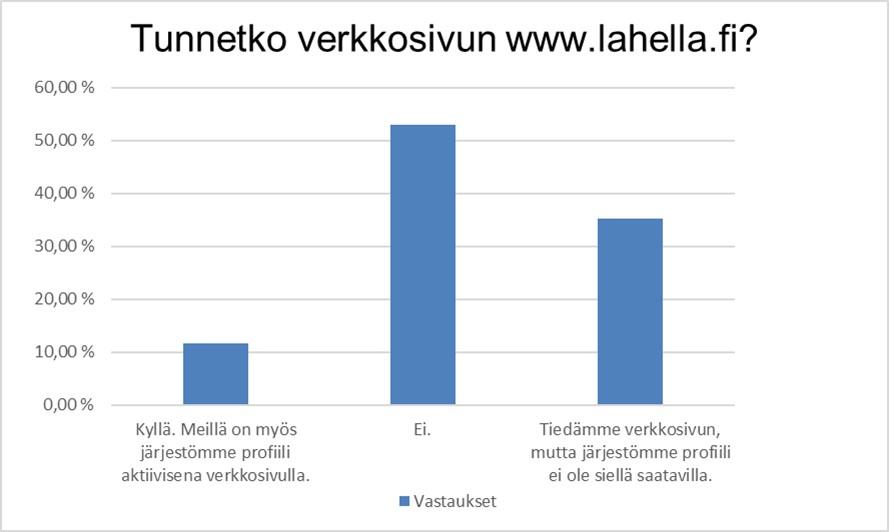
When multicultural civil society organizations were asked whether they are familiar with or use www.lahella.fi-sivustoa, only 11,8% of them have an active profile on the webpage. 52,9% are not familiar with the directory and 35,3% heard about it but do not understand how it might be helpful to have a profile on the webpage.
The language barrier might be again an issue. The webpage communicates in Finnish and Swedish and all the courses/webinars/instructions on how to use the webpage are in Finnish.
Perspectives of well-being areas
In total 21 people from 16 different wellbeing services counties answered the survey. Information is missing from the following wellbeing services counties: Lappi, Keski-Pohjanmaa, Pohjanmaa, Pohjois-Karjala, Kanta-Häme, Länsi-Uusimaa, and Ahvenanmaa.
11 surveys (52,4%) were completed and 10 surveys (47,6%) were incomplete, but still provided some information regarding the cooperation with the multicultural NGOs.
In 14 wellbeing services counties is already established some form of cooperation with the multicultural NGOs.
“In the welfare area of Vantaa and Kerava, we see cooperation with multicultural organizations as important for meeting the customer needs.”
Based on the information from the questionnaire, the existing cooperation can be divided into several areas:
- partnership financial grants (6) (grant)
- exchange of information and knowledge
- organising joint events
- info-materials development in various languages (e.g., for families with children)
- networking
- joint grant applications (multicultural NGO + wellbeing services county)
When asking wellbeing services counties if they identified in their region a need to cooperate with multicultural organisations, 2 of them provided the positive answer (Keski-Uusimaa and Päijät-Häme). It is an invitation for the multicultural NGOs to start the cooperation in more organised way.
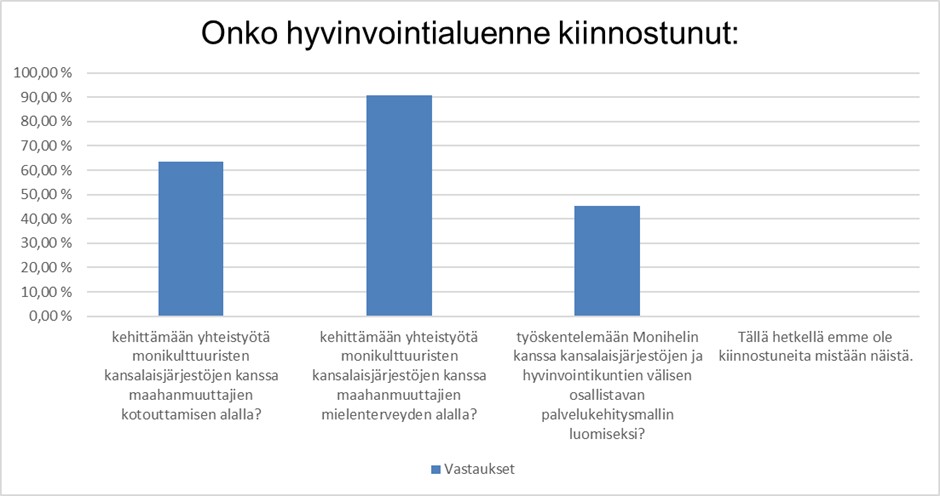
The wellbeing services counties were asked about their interest to:
(1) develop cooperation with multicultural non-governmental organizations in the field of integration of immigrants > interested wellbeing counties: Varsinais-Suomi, Keski-Uusimaa, Vantaa ja Kerava, Päijät-Häme, Satakunta, Pohjois-Pohjanmaa
(2) develop cooperation with multicultural non-governmental organizations in the field of immigrants' mental health> interested wellbeing counties: Varsinais-Suomi, Keski-Uusimaa, Kainuu, Vantaa ja Kerava, Päijät-Häme, Keski-Suomi, Kymenlaakso, Satakunta, Pirkanmaa, Pohjois-Pohjanmaa
(3) to co-create with Moniheli a participatory service development model between non-governmental organizations and welfare municipalities > interested wellbeing counties: Varsinais-Suomi, Keski-Uusimaa, Päijät-Häme, Kymenlaakso, Satakunta
This overview provides opportunities for multicultural NGOs to actively approach the well-being counties and brainstorm possible ways of cooperation.
Perspectives of multicultural organizations
Based on the statistics, the population with a foreign background is concentrated in the Uusimaa region (7). Not surprisingly, most multicultural NGOs operate in the Uusimaa region, and they wish to develop cooperation with the public authorities in the same area.
During the mapping period, we received 17 answers from the organisations in Moniheli’s network, out of which 13 were completed (76,5%) and 4 were incomplete (23,5%).
12 NGOs work in the integration of foreigners in Finland. 7 of these 12 NGOs support the mental health of immigrants.
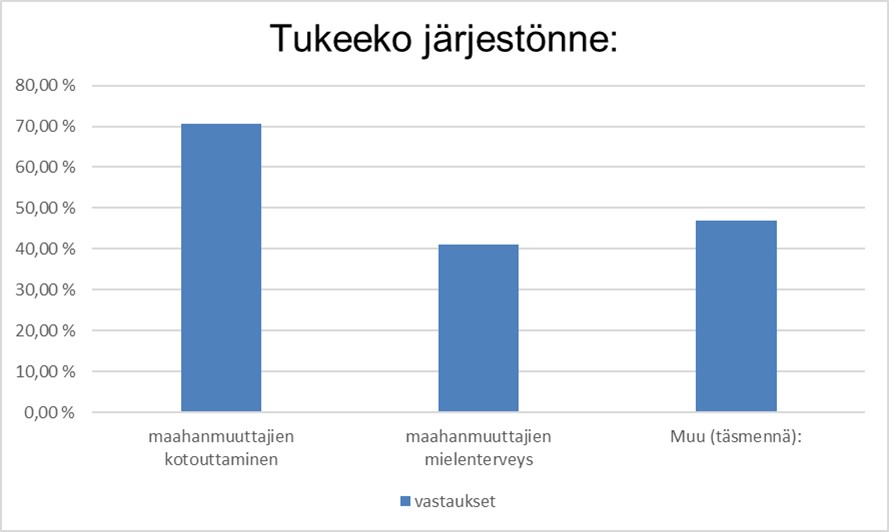
In addition, organizations offer:
- organising physical activities
- community gardening
- cultural events
- supporting volunteer work
- empowerment and advocacy for people of various descents and cultural backgrounds
- supporting employment, entrepreneurship, and skills development of foreigners
- activation of agency in different aspects of life
- supporting various age and gender groups of immigrants (children, youth, females)
- supporting multiculturalism
A little less than 30% of the respondents have already some sort of cooperation established with the wellbeing services counties in Helsinki, Itä-Uusimaa, and Länsi-Uusimaa. Only 1 NGO has an active ongoing cooperation with the wellbeing services county, few others cooperated in the past or have an active profile on www.lahella.fi website.
All the NGOs except one were interested in the development of a closer cooperation with the wellbeing services county or counties in the following areas:
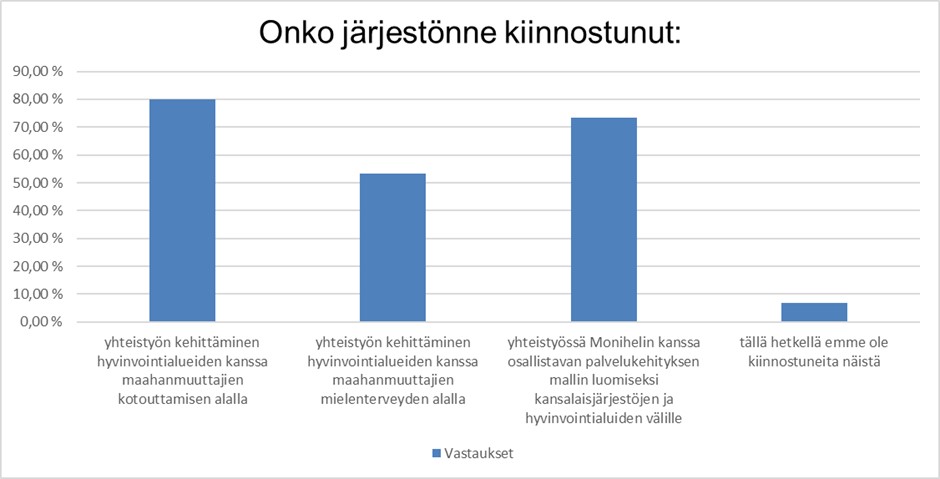
Most multicultural NGOs wish to cooperate with the wellbeing services counties in the Uusimaa area (Helsinki, Vantaa ja Kerava, Länsi-Uusimaa, Itä-Uusimaa, Keski-Uusimaa), followed by Varsinais-Suomi and Pirkanmaa. .
Conclusions
When interpreting the collected data, we can see positivessuch as (1) high interest in cooperation that was indicated by the wellbeing services counties’ professionals, as well as by the multicultural NGOs’ representatives; (2) opportunities for NGOs to participate in the decision-making processes; (3) financial support for NGOs; (4) genuine interest to meet the need of the target groups.
Based on the legislation on wellbeing services counties (7) and the new law promoting integration (8) (KOTO24) the cooperation between the wellbeing services counties, municipalities, and non-governmental organisation is crucial when it comes to the integration of immigrants. Activities and services provided by NGOs naturally complement public services and additionally offer the possibility for immigrants to integrate in their language or in the language they already know. Learning Finnish is a process, that might be stressful for immigrants when not progressing as expected.
Attention should be paid to what cooperation means to wellbeing services counties and NGOs. Wellbeing services counties mentioned mostly partnership agreements (grants) that are available for NGOs, and exchange of information, but almost no actual co-development of services.
When talking about cooperation, we should keep in mind the difference between equality and equity. Very typically the authorities assume that when something is theoretically available for everyone, everyone can participate. Many multicultural NGOs, small voluntary-based organisations, or foreigners-led organisations need an extra hand to be able to participate.
Even in Moniheli’s short mapping, it was obvious that information about important changes must be distributed repeatedly in different languages.
“I am confused by the term ‘welfare area.’ Does it have anything to do with a municipality? And what is a welfare area? I haven't heard the term before.”
This quote from one respondent shows that immigrants would benefit from better targeted communication. If someone has never heard of wellbeing services counties, how can they possibly think of cooperation with one?
Developing cooperation between welfare regions and multicultural non-governmental organizations is therefore essential:
- keep communication channels open both in clear Finnish and also in English
- if a wellbeing services county wants to have a more diverse representation e.g. in the advisory board of NGOs, it is not enough to publish an open call on the webpage in Finnish. Additional steps are needed. A personal invitation can be sent to particular NGOs. Encourage foreigners by stating that they are welcome to speak in easy Finnish or English if that makes them more comfortable.
- reconsider the necessity of writing the application for a partnership grant in Finnish (Swedish). Would it be possible to add English as the official application language?
- Multicultural NGOs should actively follow information regarding the NGOs networks in the area and actively participate in events such as networking, presentation of the NGO’s activities, different café tables, etc.
- When advisory board meets and there is a need to discuss certain matters, make sure that everyone understands and can express their opinions. Materials can be sent beforehand which would allow non-Finnish speakers to familiarise with the text and prepare their statements.
- NGOs should keep in mind the upcoming financial cuts to STEA funds and become more flexible when providing services. In many municipalities not so far away from the metropolitan area there are no multicultural NGOs operating, while there is the target group(s) present. Offering services and activities in an outreach way might be the way how to secure funds in the future. Flexibility, adaptivity, and being present where the clients are, will become more needed than ever.
- NGOs should better understand their role in the integration of immigrants. Some of the small voluntary-based NGOs providing e.g. sports or cultural activities do not necessarily see their role in the integration and might have difficulties to “translate” their own activities into the language of integration.
Moniheli's DutiesProject: Active Participation – Services Promoting Equality, Non-Discrimination, and Inclusion-project is related to developing cooperation between well-being regions and multicultural civil society organizations. In 2024–2026, Moniheli will share information about well-being regions, cooperation opportunities, and support networking between well-being regions and multicultural civil society organizations.
Moniheli will actively participate in the advisory boards to make it easier for others to follow. Moniheli will also support the wellbeing services counties when it comes to e.g. multicultural communication. Additionally, Moniheli will support more intensive interactions between the wellbeing services counties and multicultural NGOs by promoting events, networking and other opportunities for mutual cooperation.
