

Non-governmental organizations do incredibly valuable work. People are genuinely helped, real change happens in everyday life, and impact is created in ways that cannot be replaced by pure market logic.
And yet, when the conversation turns to corporate partnerships, many pause for a moment.
Not because there are no ideas. Not because companies aren’t interested.
But because valuable work has not yet been shaped into something that is easy to engage with.
Non-profit organisations do a wide range of activities at different scopes that is difficult to grasp. It can feel either too specific, too contextual or way too abstract.
I’ve had the opportunity to build corporate partnerships in very different contexts. At the start of Russia’s war of aggression, there was urgency, pressure, and a need to act quickly together with companies. Now, working in the field of digital inclusion, the work is more long-term, and I’ve had more time to reflect on these questions. There have been plenty of mistakes and successes along the way.
In both cases, I’ve noticed the same thing:
Companies don’t buy activities. They respond to clarity.
And that is good news.
Because clarity can be built.
Activities can be defined and focused, partnerships can be productized, value can be evaluated, and collaboration can be offered.
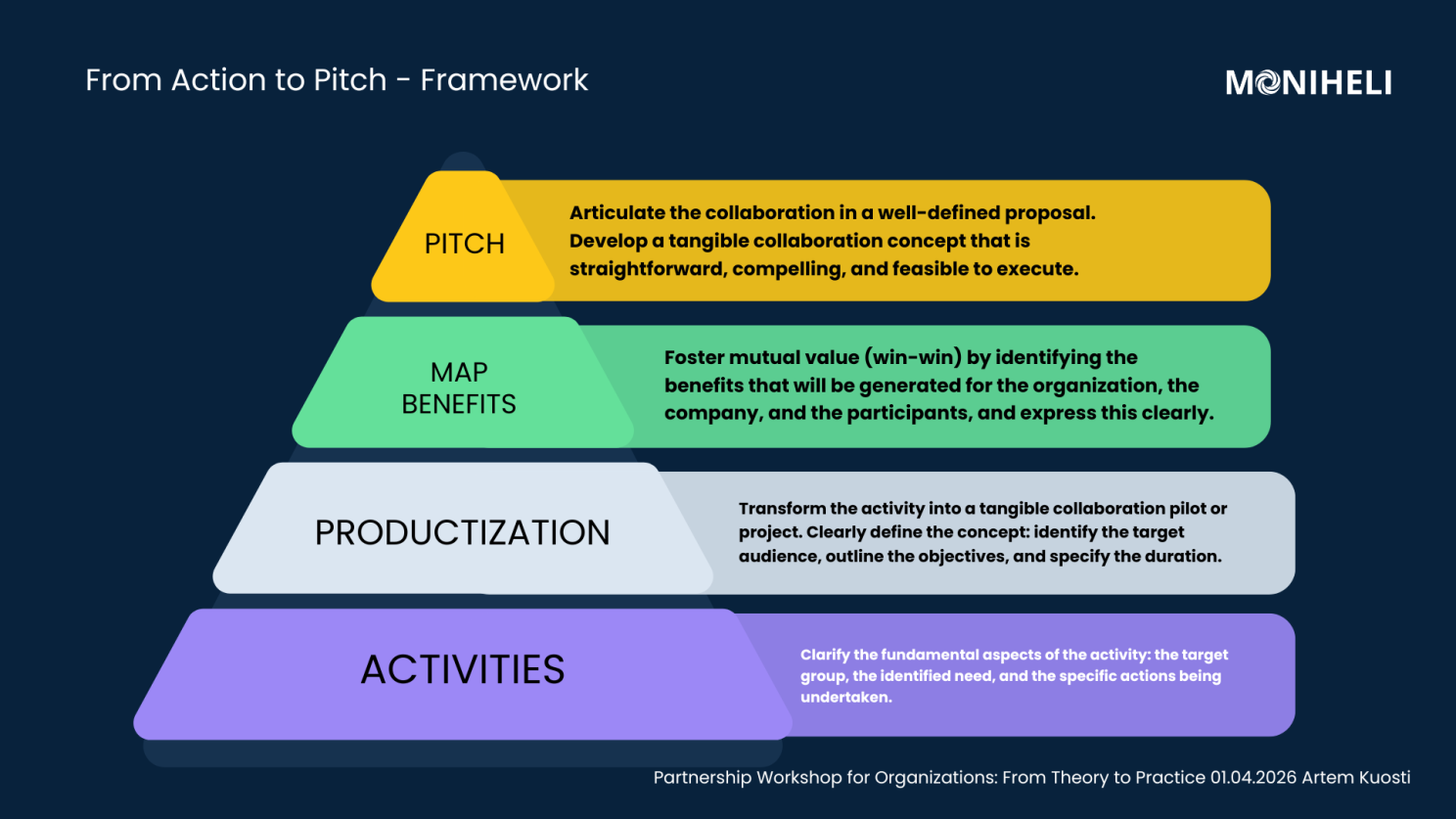
A simple model that can change a lot
I’ve started to structure corporate partnerships through one clear model, which I call From Action to Pitch Framework:
Activity → Productisation → Value → Pitch
This is not theory. It’s a practical tool.
When you run an idea through this, collaboration starts to become concrete.
1. Activity – clarify the core
Before approaching a company, it helps to clearly define which specific activity you want to build the collaboration around.
Everything starts here.
When you can explain simply:
- who you help
- what problem you address
- what actually happens in practice
something important emerges: clarity.
One sentence that has helped me a lot:
“We help [target group] solve [problem] by doing [activity]”
This is not just communication.
It’s a way of seeing your own work more clearly in the context of collaboration. It’s the starting point for building a partnership proposal.
Productisation – give the idea a form
Once the core is clear, the next step is to shape it into an accessible form of collaboration, something we can think of as productisation.
Where can a company concretely get involved?
This is often where an important realization happens:
corporate partnership is not one thing, but a set of different formats to choose from.
For example:
Pilot: Small, limited experiment → easy to start, low threshold
Programme: A structured, ready-made concept → when the activity is already established
Employee engagement: Involving staff → meaning and engagement
Impact partnership: The company enables something visible → clear story and impact
Skills-based collaboration: The company contributes expertise → a strong first step
Or is one individual actor directly sponsored? tiettyä toimijaa?
There are many options, and they can be innovated further.
It’s useful to think about both the smallest and the largest possible version.
The common denominator for all:
Target group + what happens + for how long
When these are clear, collaboration starts to feel possible.
3. Value – make the benefit visible for both sides
This is where balance is created. A true win-win.
The organization brings impact in different forms. The company brings resources, expertise, or visibility.
Get familiar with the company’s strategy, priorities, and sustainability reports.
Good collaboration happens when both sides feel they gain value.
For companies, this value can mean different things:
Business
- new customers
- new markets
- brand strengthening
Sustainability (ESG)
- concrete actions
- measurable impact
- credible storytelling
Employees
- wellbeing
- sense of purpose
- engagement
Visibility
- positive publicity
- new audiences
Strategic level
- networks
- long-term partnerships
When these are articulated openly, the collaboration becomes truly shared.
It’s also important to practice active listening here. As the partnership develops, this understanding becomes clearer.
4. Pitch – make it easy to say yes
In the end, everything comes down to one thing:
Can you explain your idea clearly enough that it’s easy to engage with?
A good pitch is not perfect. It is understandable and starts a conversation.
It communicates:
- what you do
- what you propose
- what is needed
- what the company gets
- what the next step is.
It doesn’t close the conversation. It opens it.
Draft example:
Hello,
We are organization X, and we work with people with migrant backgrounds to strengthen their digital skills, everyday coping, and access to working life.
We’ve been thinking there could be an opportunity to collaborate with you. We see a strong alignment between your company’s values and our work. The idea would be to start with a light 3-month pilot for around 15 participants. The program would include guidance, peer support, and hands-on practice.
Your role could be quite concrete: for example, your experts participating in mentoring for about 2 hours per month, as well as the possibility to use your facilities for a few sessions.
In return, we offer a concrete and visible sustainability initiative that supports both your ESG goals and your employees’ sense of purpose.
Would you be open to discussing this further in a 30-minute Teams meeting? We can explore together whether this fits your goals and how it could be shaped to suit you.
A small but important mindset
One idea has stayed especially important to me:
Better done than perfect
Corporate partnerships don’t come from perfect plans.
They come from:
- the first idea
- the first pilot
- ensimmäisestä keskustelusta.
Ja usein juuri siitä, että uskaltaa lähteä liikkeelle keskeneräisenä.
In closing
If I return to the original question:
How do you build corporate partnerships?
The answer is not complicated.
- Clarify what you do
- Shape it into something understandable
- Show value for both sides
- Make it easy to join
And above all:
Trust that your work has value.
You don’t need to invent it. You just need to make it visible.
The text has been originally published as an article on LinkedIn on Feb 2, 2026.