

Introduction
Various research findings conclude that the best integration models across multiple countries are based on the cooperation among public stakeholders (i.e. municipalities) and non-governmental organizations. (e.g. Grubb & Vitus, 2022; Humer & Agatiello, 2019; Pursch et al., 2020).
The marker of successful integration remains labor integration in most of the settlement programs (Pursch et al., 2020). Personnel of integration services pay insufficient attention to the other aspects of newcomers' life such as loneliness and lack of meaningful social networks. Schuster et al. (2022) identified the need of immigrants for frequent face-to-face meetings, but lack of time on the site of officers to meet them. This need is usually fulfilled by the NGOs.
Additionally, authors (ibid.) pointed out that "connecting new arrivals to relevant services is essential for establishing integration." Where such referrals are missing due to the lack of cooperation between the stakeholders and civil society actors, the integration of an individual may be wrecked. At the same time, the individuals can be left on their own to figure out what services are available for them. If they lack language or digital skills, or even agency to cope with the task themselves, they will never reach the services they can benefit from.
Moreover, personnel of integration services might not be trained to work with customers having severe mental health problems and traumatic experiences. If such people are being expected to learn a new language, deal with the job search, and completely new life situations, it might harm their already challenging mental health and increase their vulnerability.
Considering the upcoming financial cuts for NGOs in Finland, the study of Pursch et al. (2020) is very actual. They noticed, that when the state limits public and NGO services for immigrants, it negatively affects migrant 'life chances', i.e. equal opportunities with other members of the society.
European Economic and Social Committee (2020) published a study on the role of civil society organisations in ensuring the integration of migrants and refugees. From the key messages mentioned in the report, a few are particularly important for the development of integration services in Finland (pp. 3-4):
1.2 CSOs (civil society organisations) play an important role in migrant and refugee integration in all the countries visited. They carry out valuable work assisting or even substituting for governments by providing guidance and support in integration processes. However, their involvement in the design of integration policies and integration activities does not always correspond to the importance of their role.
1.3 Therefore, Member States should step up their efforts to achieve more structured cooperation between CSOs and government authorities so as to create synergies and make better use of the knowledge and resources available on both sides. Greater use must be made of the expertise of CSOs as practitioners when designing integration strategies and measures to increase their efficiency.
1.4 More generally, Member States should apply a multi-stakeholder approach involving local and regional authorities, employers, trade unions and civil society organisations when developing integration policies to ensure that they correspond to actual needs and circumstances and benefit migrants and refugees in an optimal way.
1.6 Despite playing an important role in the integration process of both migrants and refugees, it is still very problematic for CSOs to obtain funding. Member States should make the necessary resources available to ensure efficient and operational integration measures.
1.9 Migrants and refugees should have a greater voice in the issues affecting their lives. It is important to talk with migrants, not about them. Structures should be put in place to enable migrants to represent themselves.
1.11 Where possible, integration measures must be designed in a way that benefits the local population as well, to avoid tensions between the host population and the newcomers. This would also facilitate encounters which reduce the level of mistrust and animosity that are often seen in societies welcoming newcomers in their midst. The aim should be to ensure equal rights, obligations and opportunities for all, irrespective of ethnic background.
Moniheli’s mapping
The mapping presented in this report is the second one that Moniheli ry carried on as a part of the "Agency – services that promote equity, antidiscrimination and participation" project.
The first mapping was realized in May 2024 - June 2024 on general cooperation between wellbeing services counties and multicultural non-governmental organizations. The survey was sent to the workers of wellbeing services counties responsible for cooperation with the NGOs in the area, usually known as "NGOs coordinators", in Finnish "järjestökoordinaattorit". The survey's findings are available here: "What even are Wellbeing Services Counties?" Initial mapping of NGO cooperation in the counties
After the mapping of cooperation on the general level and studies of relevant literature, Moniheli wanted to investigate the cooperation on the service level. Specifically focusing on integration services for immigrants.
The short survey with 5 questions was sent to the managers of immigrant services in every wellbeing services county. In 3 wellbeing services counties, the contact person was unknown, and the email was sent to the general email.
When developing the survey, we worked with 2 hypotheses based on the previous mapping's findings:
- The services of multicultural civic organizations are not utilized in direct client work related to integration.
- The service needs assessment template used in wellbeing services counties lacks the space for actual planning and following up of the client's involvement in NGO activities.
The survey consisted of the following questions:
- In which HYA (including Helsinki) do you work?
- Which customer and patient information system is used at HYA?
- As part of the service needs assessment in accordance with the Social Welfare Act for adult social work, do you plan purposefully also cooperate with NGOs? If yes, in what way/scope?
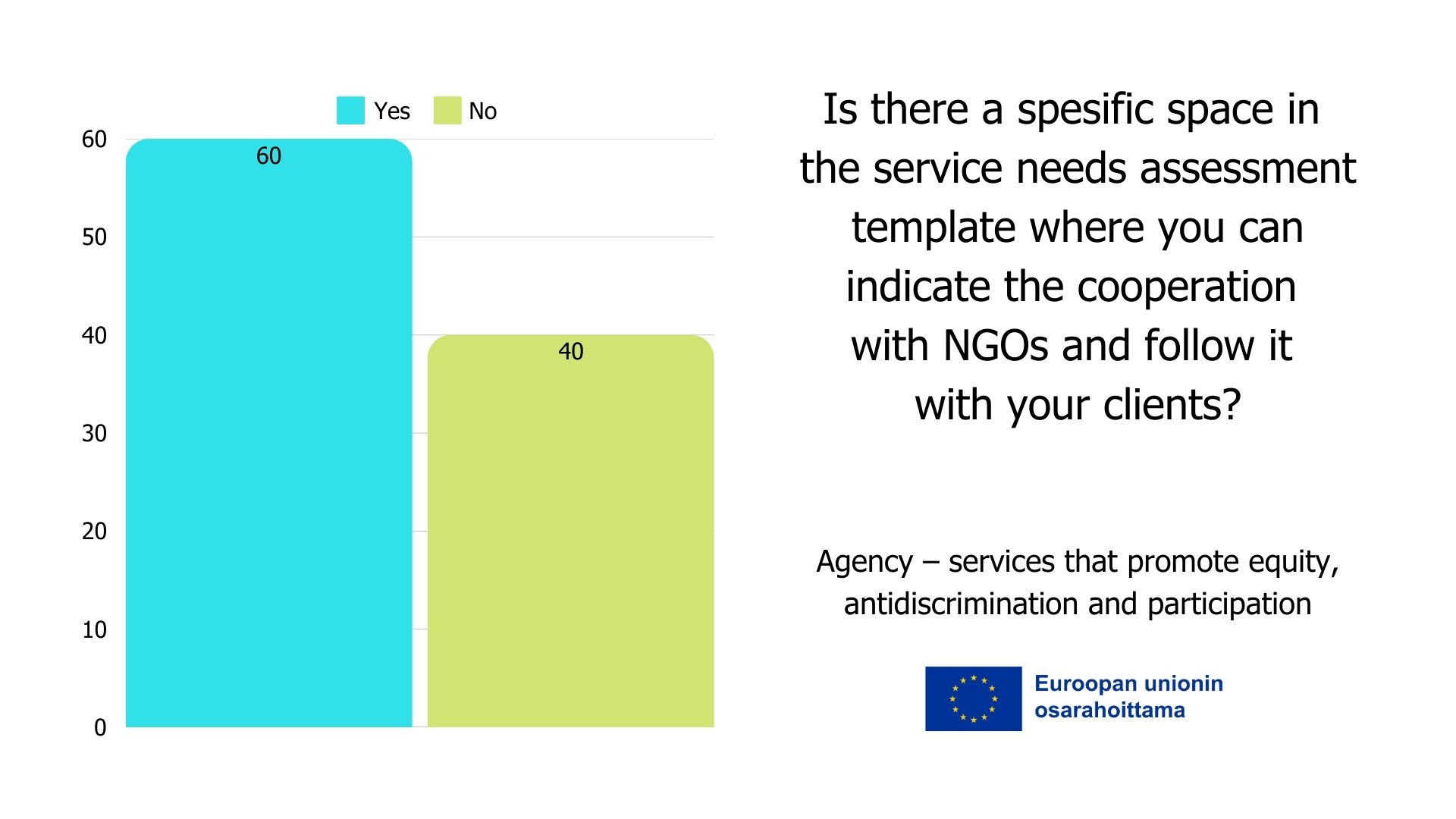
- Is there a specific space in the service needs assessment template where you can indicate the cooperation with NGOs and follow it with your clients?
- Could you send me the service needs assessment template for future research of the topic? Thank you in advance!
- Identification and contact information of the person filling in the survey.
Findings from the survey
The return rate of the filled-in surveys was low (22.73%) and therefore it is not possible to generalize the findings. Nonetheless, it is possible to describe trends, that would be at the later stage of the project clarified in the personal interviews.
Out of 22, only 5 wellbeing services counties returned the filled in survey (Itä-Uusimaa, Vantaa ja Kerava, Varsinais-Suomi, Helsinki, Lappi).
There are used multiple client and patient information systems in wellbeing services counties, including Effica, ProConsona, Apotti, and Abilita.
There were various answers provided to the question regarding the service needs assessment and purposeful cooperation with NGOs:
- in 3 wellbeing services counties, participation in NGOs activities is checked and eventually planned based on the client's needs and leisure activities.
- only 1 out of these 3 wellbeing services counties consults NGOs when making the referral of the clients to their activities.
- 1 wellbeing service county does not plan any cooperation with the NGOs.
- 1 wellbeing services county plans it only in one bigger city in the area, as there are no NGO activities available in the remote regions.
- none of the wellbeing services counties involve the NGOs in the needs assessment of the integration services’ customers.
Wellbeing services counties also have different experiences with the needs assessment templates. 60% stated, that they have a specific space in the form where they can indicate cooperation with NGOs, while 40% do not have such an option in their needs assessment forms.
Based on the individual responses, Apotti was identified as the client and patient information system with the particular space to specify the cooperation with the NGOs.
However, the wellbeing services counties that do not use Apotti, i.e. their information system do not provide space to indicate the cooperation with the NGOs, answered in the previous question that the customers' participation in NGOs' activities is being planned. Therefore, this question remains unclear and further clarification is needed.
For the comparison among different client and patient information systems, we asked respondents for a copy of the service needs assessment form. We did not receive a specific form, but the respondents stated, that the synchronizations of the information systems are in progress and should be introduced in 2025.
Those using Apotti mentioned that because of transferring all social welfare data into Kanta, all the documents must be compatible with specifications in Sosmeta määritysten kanssa.
One respondent shared a direct link to information in Sosmeta on what structure the service needs assessment for working-aged people must have.In the form, there is not a specific place where the cooperation with NGOs can be planned – something under the title “Cooperation with the civil society” or similar. Regardless, there are parts of the form like “Immigration & Integration”, “Life management” or “Additional information”, where such planning can be done and followed-up.
Unfortunately, as the results of the mapping showed, if there are no clear instructions to include cooperation with NGO sector, the practice varies among wellbeing services counties and the complementary role of NGOs in the integration of immigrants might stay unnoticed for the pity of the customers.
Conclusions
Mapping the cooperation in the integration services between wellbeing services counties and multicultural non-governmental organizations was driven by finding the answers to the hypotheses we formulated before designing the survey.
Due to the low return rate of surveys, we cannot take the findings for granted and further investigation is required. As planned in the project proposal, more information will be acquired during the personal interviews with the managers of integration services in various wellbeing services counties, as well as with the representatives of the multicultural non-governmental organization. Interviews are planned for the first half of 2025.
Our first hypothesis on a lack of cooperation with multicultural NGOs in the integration of foreigners was confirmed only partially. From the information gained in the survey, the actual answer would be, that the level of cooperation depends on:
- type of the region where wellbeing county operates – in the areas with the higher density and lots of NGOs operating in the area, cooperation is more common. In regions such as Lapland, cooperation is to a large extent impossible.
- type of the service needs assessment template used in wellbeing services counties – Social workers who use Apotti seem more likely to plan collaboration than social workers who use other information systems. Since we do not know these information systems and their structures, we cannot currently investigate this conclusion in more detail.
- unit practices integration services' workers seem to (a) not cooperate with the NGOs at all; (b) map the clients' participation in NGOs services; and (c) refer the clients to the NGOs' activities. Other types of cooperation were not mentioned.
The second hypothesis on a lack of the space for actual planning and following up of the client’s involvement in NGOs activities in the service needs assessment template was partially confirmed.
In the actual assessment forms, there is no specific space for indicating cooperation with the NGOs. There are other spaces, under which such cooperation can be mentioned, planned, monitored, and evaluated. The practice shows that it depends on the good practices and instructions in the particular integration services unit. Social workers decide if civil society activities will be considered in the integration of immigrants at all and if yes, then which ones.
Development ideas
What should wellbeing services counties take into account when developing a service needs assessment for integration? Cooperation between public stakeholders and NGOs is crucial in direct client work, but it is also essential in the development of appropriate integration policies and services.
Therefore, we recommend to the Finnish wellbeing services counties:
- To include cooperation with the NGOs in the service needs assessment forms. This should be unified in all wellbeing services counties, even if the region specification does not allow cooperation. The situation can be changed in the future, and NGOs can be operating in the areas where they are currently missing. As the practice showed, when the specific question of cooperation with NGOs is not addressed, the actual cooperation is rarely planned.
- To adopt a holistic approach to integration.
For the newcomers to the country, not only language and work are important. A holistic approach to integration should be adopted, where the distribution of the task between public authorities and NGOs will be clearer. NGOs supplement authorities also in the work integration, but their activities are crucial in the other aspects of integration (cultural, social, religious, etc.). As the integration is the 2 ways process, the contacts with the majority must be established and developed and NGO activities are the natural candidates to maintain also this task. - Cooperation with non-governmental organizations should be developed at the service level.
Social workers and other personnel should know about the NGOs available in the area, not only the NGO coordinators (järjestökoordinaattorit). The actual co-development of services with the customers, NGO representatives, employers, and public authorities should be formed. - To perceive the civil society sector as the partner.
Wellbeing services counties as well as NGOs are following the same goal – to improve the integration of the foreigners in Finland. They are not in competition. Instead, they are the natural partners. It is also recommended to understand the power relationships between them. The power balance is uneven, especially when NGOs' expertise is not being recognized and if the invitation to cooperation is just formal - without the actual commitment to implement suggestions of the civil society actors. NGOs are also competing for the grants provided by wellbeing services counties. If one partner is a donor and the other a beneficiary, the power distribution between them is naturally unequal. NGOs might feel obliged not to criticize the donor as they depend on the provided funds. The extra step to dismiss these unequal power relationships is therefore in the hands of public authorities. - To assess, monitor & evaluate customers' integration.
There can be piloted a model where NGOs would not only be a referral point for customers but where the actual cooperation would be implemented. When referring the customer to the NGO services, it should be clear what goals can be achieved there and how to follow up the clients' participation in NGO's activities. A clear timetable and measurable goals should be established and checked repeatedly in cooperation among the client, the worker of the wellbeing services county and the NGO worker. Just then the public authorities will have a more complex overview of the individual's integration. - Increasing the visibility of small civil society organizations.
The number of NGOs in Finland is extensive, and we do not expect that authorities would know all of them. Still, we want to point out, that small voluntary-based organizations are very important and have direct contact with the target groups. In the case of multicultural NGOs, these small associations usually support the groups that are most difficult to reach by other services.
References
European Economic and Social Committee. (2020). The role of civil society organisations in ensuring the integration of migrants and refugees (project summary report). Available: qe-01-20-525-en-n.pdf, [cit. 22nd of October 2024].
Grubb, A. & Vitus, K. (2022). Kansalaisten integroituminen toimeksiantoyhteisöjen kautta: Ehdollisen ja asiakaslähtöisen osallistumisen monialaisesta yhteistuotannosta. Nordic Journal of Migration Research, 12(3), s. 326–345. DOI: https://doi.org/10.33134/njmr.42.
Humer, L. & Agatiello, G. (2019). Paikallisviranomaisten ja kansalaisyhteiskunnan toimijoiden välisen yhteistyön edistäminen maahanmuuttajien ja pakolaisten kotoutumisessa ja sosiaalisessa osallisuudessa: Challenges and Opportunities. Eurodiaconia. Saatavilla: Paikallisviranomaisten ja kansalaisyhteiskunnan toimijoiden välisen yhteistyön edistäminen maahanmuuttajien ja pakolaisten kotoutumisessa ja sosiaalisessa osallisuudessa | Kotoutumista käsittelevä eurooppalainen verkkosivusto, [cit. 22nd of October 2024].
Pursch, B., Tate, A., Legido-Quigley, H., & Howard, N. (2020). Terveyttä kaikille? Laadullinen tutkimus kansalaisjärjestöjen tuesta rakenteellisesta väkivallasta kärsiville maahanmuuttajille Pohjois-Ranskassa. Social Science & Medicine (1982), 248, 112838–112839. https://doi.org/10.1016/j.socscimed.2020.112838
Schuster, M., Kraft, M., Hägg-Martinell, A., Eriksson, H., Larsen, J., & Ekstrand, P. (2022). Challenges and Barriers to the Social Integration of Newly Arrived Immigrants in Sweden. Journal of Identity and Migration Studies: JIMS, 16(1), s. 23–177.
United Nations. Tietoa kestävän kehityksen tavoitteista. Available at: 17 TAVOITETIEDOT | Kestävä kehitys, [cit. 22nd of October 2024].
For more information feel free to contact:
Lubica Vysna
050 530 0720
