
Many associations start with an idea, something they want to improve, change, or develop for their community.
However, an idea on its own is not yet a project. To become a project, the idea needs structure, purpose, and clarity.
This article explains how to move from an initial idea to a clear project plan that can realistically be funded and implemented.
Table of contents
From idea to project: what’s the difference?
An idea is a starting point, a thought about something that could be done.
A project is a concrete plan for action. It is a structured way of working.
A project is:
- Need based: responds to a clearly identified issue or challenge
- Goal-oriented: has defined objectives and a specific target group
- Time-bound: has a limited time frame
- Resource-based: uses planned resources (people, budget, tools)
- Development focused: aims to create change or improvement
- Result oriented: produces measurable outcomes that can be evaluated
Without these elements, an idea remains difficult to assess and is unlikely to convince funders that it can be implemented successfully.
Projects typically move from defining an idea to planning, implementation, and evaluation. This article focuses on the first stage, where the idea is clarified and developed into a project.
How does an idea become a project?
Turning an idea into a project is a gradual process. It involves understanding the need, identifying who the project is for, checking whether the idea is realistic, and defining what the project aims to achieve.
Step 1: How to identify the real need?
A strong project always starts from a real need. This means identifying what should change, for whom, and why.
a) Needs assessment
A need refers to a gap between the current situation and the situation you want to achieve.
A needs assessment is a systematic process for identifying and closing gaps between current conditions and desired future outcomes. It helps answer questions such as:
- What is happening now, and what should be different?
- Who is the most affected by this issue?
- What are the causes of the problem?
This also involves asking questions such as “What evidence supports this need?”
Use reliable data and feedback in your needs assessment. It is useful to combine different sources of information, such as statistics, reports, and feedback from the target group, to build a more accurate understanding of the need. This shows funders that your project is grounded in reality.
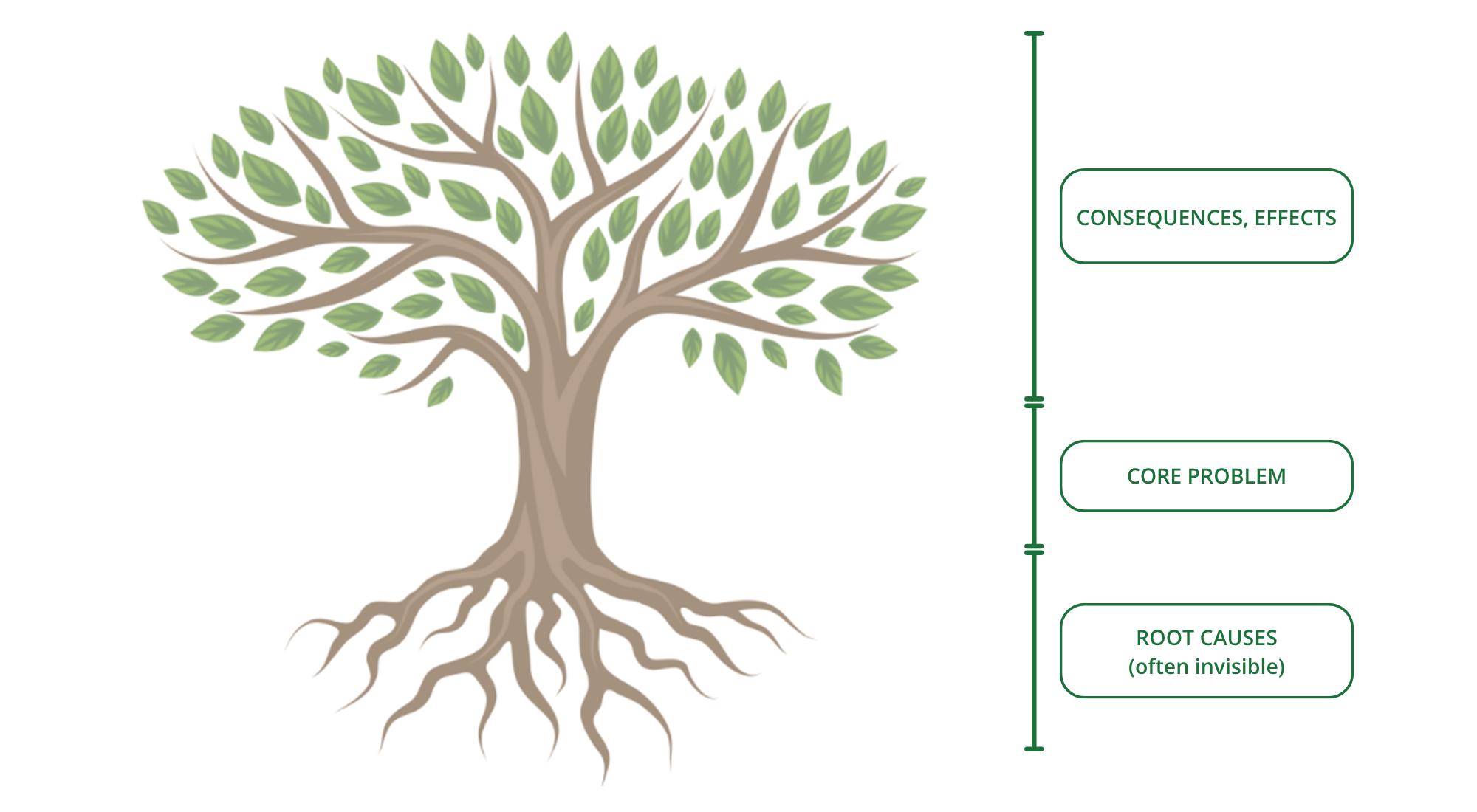
To help you visualise the problem, its causes, and its consequences, you can use the Problem tree analysis :
b) Who is the target group?
Once the need has been identified, the next step is to define who the project is intended to support or benefit. This group is called the target group.
The target group can be a specific group, such as young people, migrants, or volunteers in a certain area. A project can also have several target groups, for example when different groups are involved in different ways. In this case, it is important to define each group.
Defining the target group precisely helps you make clear choices about:
- who the project is for
- what type of activities are needed
- how results will be measured
A well-defined target group also makes it easier to set realistic objectives and explain why the project is needed.
c) Where can you find information?
Reliable data and background information can come from different sources:
Statistics and research, for example:
SOSTE (Suomen sosiaali ja terveys) research and reports
Provides analysis and research on the social and health sector, including trends, challenges, and policy developments in Finland.
(in Finnish)
Finnish Institute for Health and Welfare (THL)
Provides data on population wellbeing, health, and social inclusion.
Statistics Finland
Offers official statistics on population, economy, and living conditions in Finland.
Municipal and regional wellbeing reports, for example:
Helsinki Welfare report
Presents data and analysis on wellbeing and living conditions in Helsinki.
Regional wellbeing report and plan for the Vantaa and Kerava wellbeing area 2023–2025 (VaKeHyvä)
Describes regional challenges, priorities, and development needs.
(in Finnish)
Paikalliset ja alueelliset hyvinvointikertomukset Suomessa (Hyvinvointikertomus.fi)
Provides access to wellbeing reports from different municipalities and regions.
(in Finnish)
Feedback from your members or target group::
Involving your community is especially important. It helps ensure that your project is relevant and grounded in real experiences.
Step 2: How to check whether the idea is realistic and relevant?
Once the need is identified, the idea must be examined in its context. This helps determine whether it can realistically be developed into a project.
a) Internal factors
Internal factors refer to elements inside your associationthat influence whether an idea can be developed into a project.
- Mission: How does the idea support your association’s goals and values?
If the idea is disconnected from your core purpose, it will be hard to justify as a project. - Previous work: What experience or activities have you already done on this topic?
Earlier work can strengthen the project and provide a foundation for development. - Resources: What skills, people, time, and tools are available for the project?
Available resources affect what can realistically be implemented. Limited resources may require adjusting the scope of the idea.
This reflection also helps identify possible limitations, such as missing skills, limited time, or lack of experience.
b) External factors
External factors come from your environment and fundersand help you fit your idea into a broader context.
- Funding criteria: What do funding calls actually ask for?
Each funder asks for something slightly different. Your idea has to match those to be funded. - Funder’s mission: How does your idea connect to the funder’s goals?
- Existing initiatives: What is already being done on this topic by others?
Understanding this helps you avoid duplication and show added value. Funders may reject projects that repeat existing work or do not clearly show their added value, so it is important to identify what already exists and how your project complements it. It can also highlight potential challenges, such as overlapping activities or competition for funding. - Public discussion and research: What do studies, statistics, or public debates say?
Data and reports help you justify the need: they make your case stronger. - Other opportunities: Are there networks, partnerships, or trends that support your idea?
Sometimes networks and partnerships can make it more viable.
c) Initial feasibility: can the project be carried out in practice?
Even if an idea is relevant and well aligned with your context, it may still be difficult to implement in practice. At this stage, the focus shifts from analysing the idea to assessing its feasibility. This includes identifying potential constraints and risks, such as legal or technical barriers, unrealistic timelines, or dependence on uncertain funding.
This step helps determine whether the idea should be adjusted, simplified, or reconsidered before being developed into a project.
*
Together, these reflections help you understand understand why your idea matters, who it serves, and where it fits in a broader social context. Being honest at this stage helps prevent over-ambitious plans that are difficult to deliver later.
Once the idea has been assessed and refined, it is important to identify who should be involved in the project.
Step 3: Who is involved and affected?
Projects rarely involve only the target group. They affect and involve different people and organisations, both inside and outside your organisation. These are called stakeholders. They have an interest in the project or can influence its success.
Stakeholders can be divided into two main categories:
- Internal stakeholders: Staff, volunteers, board members.
- External stakeholders: Target groups, partner organisations, local authorities, community groups, and funders.
Different stakeholders may play different roles in a project. Some benefit directly from the project, while others support, fund, influence, or help implement it. Understanding each group’s interests and influence helps you plan communication and involvement throughout the project.
At this stage, focus on:
- who needs to be involved
- who influences success
- who needs information or participation
a) How do you work with stakeholders?
Once stakeholders have been identified, the next step is to understand how they relate to the project.
Projects do not take place in isolation. Their success depends on how well they align with the needs, interests, and capacities of the people involved. Identifying stakeholders early helps ensure that the project is relevant, supported, and realistic.
A simple stakeholder analysis helps you:
- understand different needs and expectations
- identify who can support or influence the project
- avoid conflicts or duplication
- build cooperation and partnerships
You do not need complex tools to do this. For small organisations, a simple list with notes is enough.
You can reflect on each stakeholder by asking:
- What are their needs or interests?
- How can they contribute?
- How should you communicate with them?
More structured approaches may also consider:
- influence (how much power they have)
- interest (how much they care about the project)
The aim of stakeholder analysis is to ensure that the project is well adapted to the people involved and its context.
Want to know more?
🔗Project/Programme Planning Guidance Manual (IFRC, in English), page 16
This guide presents a comparative table to identify stakeholders and analyse their interests, influence, capacities, and potential impact on the project.
b) How can cooperation strengthen your project?
Some stakeholders can also become partners in the project. Good cooperation partners can be other associations, companies or local authorities.
Working with others can strengthen your project by helping you:
- share resources and reduce costs
- reach more participants
- gain expertise
- increase credibility with funders
Collaborative projects are often more attractive to funders, as they demonstrate capacity and sustainability.
You can explore potential partners through our 🔗Member Directory
Want to know more?
🔗Fundraising and sponsorship - What should be considered when planning fundraising? The importance of cooperation with different companies
Explains the role of cooperation with companies and why it is important for associations.
🔗Cooperation and Partnerships (Pakolaisapu.fi)
Explains how collaboration between organisations can support project implementation and strengthen impact.
Step 4: What does the project aim to achieve?
a) What change do you want to create?
Once the need, target group, and key stakeholders are clear, you can define what your project aims to achieve, this is your overall goal.
Objectives Objectives then break down this goal in more concrete and measurable steps. They describe the change the project will create, not just the activities you plan to run.
A strong objective answers:
- What change will happen?
- For whom will it happen?
- By when will it happen?
- How will we know it happened?
A common way to define clear objectives is to use the SMART model.
b) How do you define clear objectives? (SMART)
The SMART model is a simple and widely used tool in project work, helping organisations define clear and measurable objectives, which is often expected in funding applications.
SMART objectives are:
- Specific – clear and concrete
- Measurable – progress can be measured and/or tracked
- Achievable – realistic with your resources
- Relevant – linked to your mission and the identified need
- Time-bound – with a clear timeframe
Example
By December 2028, 30 immigrant women in Helsinki will have completed a basic digital skills course, increasing their confidence in using online public services.
→ S: Increase digital skills among immigrant women.
→ M: At least 30 participants complete the digital skills training.
→ A: Training sessions once per week for three months.
→ R: Supports our mission to improve social inclusion.
→ T: By the end of 2028.
Clear objectives are the basis of good planning, monitoring, and reporting.
Step 5: How will you achieve your objectives?
Once your objectives and stakeholders are clearly defined, the next step is to plan how the project will be carried out in practice. This means translating your objectives into concrete actions, organising them over time, and identifying the resources needed.
a) What activities will you organise?
Activities are the concrete actions you will implement to achieve your objectives and produce the results needed for the project. They should be directly linked to the change you want to create (For example: organising workshops or training sessions, providing counselling or support services or running events, awareness campaigns).
Each activity should contribute clearly to one or more objectives. This helps ensure that your project remains focused and coherent.
For each activity, consider how much preparation work is needed (coordination with others, preparations, concrete planning, marketing if needed, evaluation…) and who will do it. Scheduling and responsibilities are central when considering the amount of (paid) work in the project. It is easy to plan more activities than can realistically be implemented.
b) When will the activities take place?
At this stage, you do not need a detailed schedule. A simple timeline is enough to:
- estimate the duration of each activity
- define the order in which activities take place
- identify key moments (start, main activities, closing phase)
- check that the project fits within the planned timeframe
This also helps you assess whether your objectives are achievable within the available time. It also helps you identify potential delays or overlaps between activities.
A good timeline is:
- realistic, based on actual workload, not assumptions
- linked to resources, especially the number of people involved
- structured, showing the sequence of activities clearly
- a planning tool, used to organise and sequence activities over time, not just list dates
c) What resources are needed?
To implement your activities, you need to identify the resources required. These include all the elements necessary to carry out the project in practice.
Resources may include:
- Human resources: staff, volunteers, partners
- Material resources: spaces, equipment, tools
- Time: availability to plan and run activities
- Financial resources: the amount of money needed to carry out the project
At this stage, it is enough to identify the main resources required compare them with what is already available in your organisation. This helps you see what can be used and what still needs to be secured.
These resources will later be translated into a budget.
d) What about the budget?
The budget translates your planned activities and resources into costs, such as:
- staff costs or compensation,
- materials and equipment,
- space rental and logistics,
- communication and external services.
You do not need a detailed budget yet, but it is important to:
- identify the main cost categories
- understand the overall cost of the project
- check whether the project is financially realistic
A more detailed budget is usually developed later, especially when preparing a funding application.
Reserve sufficient time to build your budget. This may require some research, such as estimating salary costs, employer contributions, or requesting quotes for services. A clear budget also helps present your project clearly to others.
Step 6: How do you prepare your project plan?
At this stage, you have gathered all the key elements of your project: the need, objectives, stakeholders, activities, timeline, and resources. The next step is to bring these elements together into a clear and structured project plan.
A project plan is a document that summarises your project in a coherent way. It helps you:
- clarify your ideas
- communicate your project to others
- prepare for funding applications
You do not need a complex document. For many associations, a simple and clear structure is enough.
A basic project plan usually answers the following questions:
- Why is the project important? (context and identified need)
- Who is the project for? (target group and stakeholders)
- What is the goal of the project? (objectives)
- How will the project be implemented? (activities and timeline)
- What resources and budget are needed? (resources and costs)
- How will you know if the project is successful? (expected results)
The goal is not to be perfect, but to have a clear and realistic overview of your project. This document can then be refined later, especially when applying for funding or starting implementation.
*
A strong project plan grows from both vision and evidence. It is built on a clear need, realistic objectives, and careful planning of activities, time, and resources. Once this foundation is in place, you are ready to move forward.
Want to learn more?
Here you’ll find additional resources to help you go further in planning and developing your project.
Further guidance and practical tools
Ensimmäinen projektisi: näin teet projektisuunnitelman – Kumura.fi (in Finnish)
Explains step by step how to build a simple project plan for your first project.
Association Resource Library: Projects – Pakolaisapu
Provides practical guidance on project planning for associations, including key elements of a project plan and how to structure it.
SWOT analysis template – Moniheli
A simple visual tool to help you assess your idea and check whether it is realistic and relevant by identifying strengths, weaknesses, opportunities, and risks.
Online course: Project Cycle Management in Development Cooperation – Fingo
Online course introducing key concepts such as needs assessment, stakeholders, and project planning.
More advanced resources
Project/Programme Planning Guidance Manual – IFRC (in English)
Provides a more detailed introduction to project planning, including needs analysis, stakeholder analysis, and result-based management.
PM4NGO DPro Guide – Quick Guide (in English)
Introduces key project management concepts used in NGO work, including project logic, objectives, and planning tools.